


Turn your fall data into a plan
Start with a free 30-minute team review to name your priority students before winter break.
Learning Entry 1: Culture Is What We Practice, Not What We Post
Relationships
Learning Entry 4:
Leading with Hope - The Case for Optimistic Systems
Why sustaining hope requires relationships, shared responsibility, and organizational support
Alesha Bates · October 22, 2026 · 7 min read
When Educators Remember Why They Started
For several years, I've had opportunities to teach educators through graduate coursework. At our first in-person meetings, teachers arrived from across Minnesota with professional ambitions and everything they were carrying at the start of a school year. Many were exhausted. They were meeting student needs, managing their classrooms, and balancing personal responsibilities while pursuing further learning.
As the course continued, the relationships changed the conversations. Someone described a challenge, and another educator explained how they'd approached something similar. They exchanged ideas and recognized that they weren't alone. By the end, I heard people reconnecting with why they'd entered the profession. Their challenges hadn't disappeared, but they had relationships that helped them see new possibilities. Everybody needs somebody.
Hope Is Relational, but It Is Not Simply Positivity
Connection is one of my core values. I've always preferred talking face-to-face when possible, but I've learned that supporting someone doesn't mean immediately solving every problem. Earlier in my life, I sometimes interrupted because I was eager to share my experiences. Now I try to listen first.
Edmondson's (1999) work on psychological safety offers one lens for understanding why this matters: people need conditions where they can ask questions, acknowledge uncertainty, and raise concerns. Optimism shouldn't require educators to pretend that challenges don't exist. We need to understand what people have experienced before deciding what support they need.
When Passion Encounters Limited Capacity
I've been in district meetings where educators were passionate about student needs, but uncertainty emerged when the discussion turned to action. Who would complete the work? Where would funding come from? How could another responsibility fit into the schedule? Those realities can make it difficult to maintain enthusiasm.
SEL Blueprint grew partly from my memory of searching for usable instructional resources when time was scarce. But resources alone can't resolve every challenge. Weiner (2009) distinguishes shared commitment from shared belief in organizational capability. Leaders need to examine both: Do people value the change, and do they have the time, knowledge, tools, and support to carry it out? Asking for more enthusiasm won't solve missing organizational conditions.
From an Optimistic Leader to a Supportive System
I've worked with administrators who believed deeply in their staff and made themselves available when challenges arose. That matters, but sustained improvement can't depend entirely on one passionate person. We encourage SEL Blueprint schools to build teams that share responsibility and develop their practices together.
I think back to the elementary school where we worked to ensure every student was known. Our approach mattered because we developed shared language and collective responsibility. Bryk and Schneider (2002) help explain the role of relational trust in supporting that cooperation. Hope becomes something people can experience when they know where to find support, can participate in learning, and see that their feedback informs decisions.
Trusting the Process
There were days in my special education classroom when my students and I needed to slow down, breathe, talk, and reconnect before continuing. Adults need those moments, too. During the pandemic, I anonymously mailed encouraging notes to friends and saw how meaningful a small act of connection could be. Yet a positive note cannot fix an unmanageable workload or supply missing resources. Encouragement must sit alongside practical support.
I'm learning to trust the process in my own professional journey. I don't have to resolve every challenge immediately. Connection, identity, and grounding help me think about what I need to sustain my work and how I can support others. Schools need to do the same for educators rather than relying on individual perseverance to compensate for missing conditions.
Hope becomes sustainable when people experience enough connection, support, and shared progress to believe they can continue moving forward together.
A Shared-Hope Systems Check
| Examine | Ask | Possible move |
|---|---|---|
| Connection | Can educators learn from one another? | Build collaborative learning routines. |
| Voice | Can people discuss challenges honestly? | Close the loop on feedback. |
| Capacity | Are time and resources sufficient? | Clarify priorities and support. |
| Ownership | Does work depend on one champion? | Distribute knowledge and responsibility. |
| Progress | Can people see what is improving? | Review evidence and acknowledge progress. |
Reflect. Connect. Grow.
Reflect. When have relationships renewed your professional purpose?
Connect. Where does hope depend on individual effort rather than organizational support?
Grow. Build one routine that combines connection, practical support, and visible progress.
References
Bryk, A. S., & Schneider, B. (2002). Trust in schools: A core resource for improvement. Russell Sage Foundation.
Edmondson, A. (1999). Psychological safety and learning behavior in work teams. Administrative Science Quarterly, 44(2), 350–383. https://doi.org/10.2307/2666999
Weiner, B. J. (2009). A theory of organizational readiness for change. Implementation Science, 4, 67.
Explore More In this series
Entry 4 · Leading with Hope - The Case for Optimistic Systems
Bring This Entry to
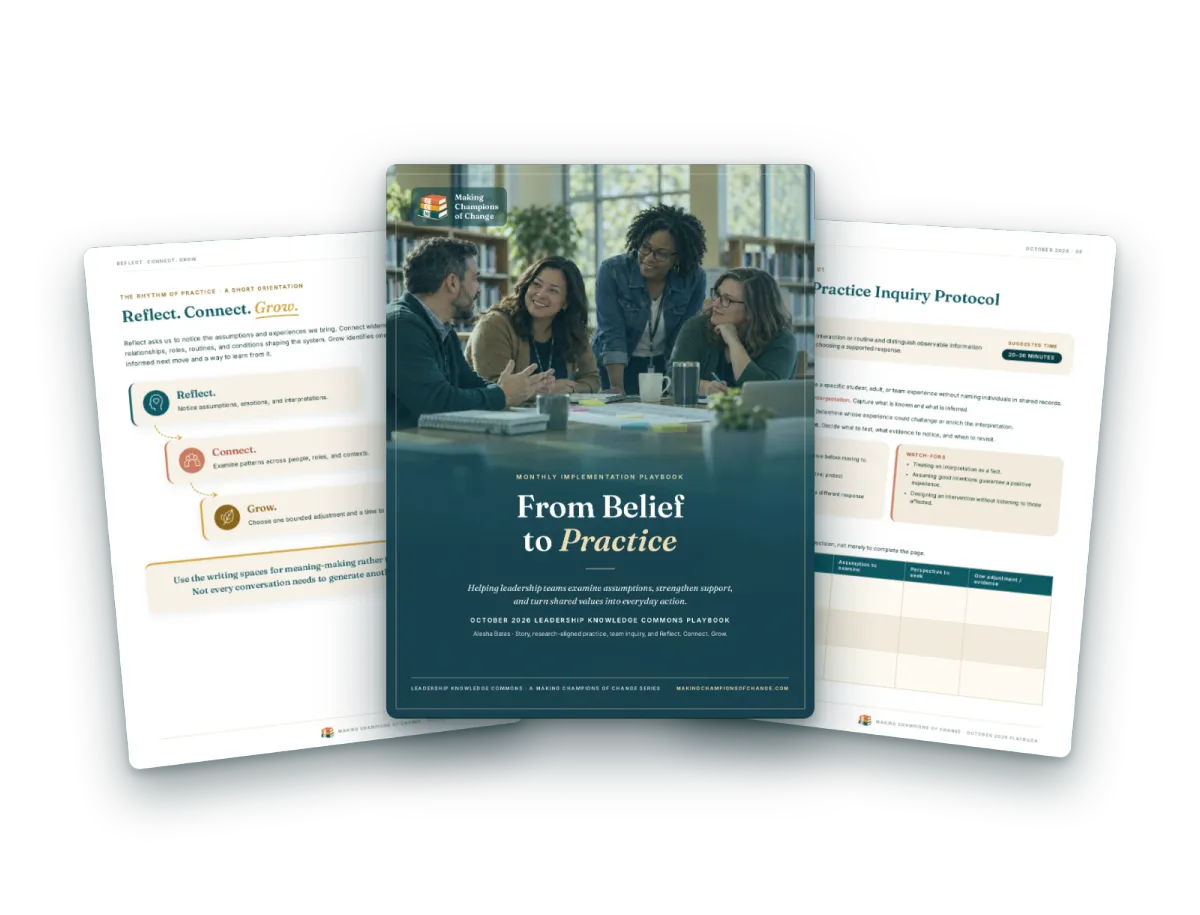
Your Team
Use the Belief-to-Practice Inquiry Protocol to help your team separate what you saw from what you assumed, then plan one supported change with Reflect. Connect. Grow. prompts.
Talk it through with us.
Bring us the work your team is carrying. If you want another perspective on a priority, challenge, or implementation question, we can help you think through what makes sense next.
Before You Go
Think about one idea from this entry that connects to the work in front of you.
What is one thing worth noticing, discussing, or doing differently because of it?
Reflect: What stood out to you in this entry?
Connect: Where do you see this showing up in your own team or system?
Grow: What is one next step worth trying, discussing, or revisiting?

A leadership and implementation ecosystem helping education leaders turn good ideas into change that lasts.
Explore
Learn with us
Opportunities
Stay in the Conversation
Get new playbooks, leadership tools, and district stories in your inbox.
© 2026 Making Champions of Change. All rights reserved.