
Learning Entry 1: Culture Is What We Practice, Not What We Post
Relationships
Learning Entry 1:
Beliefs Drive Behavior -
The Hidden Architecture
of Systems
How the assumptions we carry influence the relationships we build and the opportunities we create
Alesha Bates · October 01, 2026 · 6 min read
The Student Who Changed My Understanding of Connection
I remember working with a student who had experienced significant adversity. Before she entered my classroom, I already knew parts of her story, and I believed I understood what she needed. I wanted to be the person who made a difference for her. I spent an entire school year trying to build that relationship, asking questions, offering support, and searching for ways to reach her. By the end of the year, I felt as though I had tried everything I knew.
When we returned the following year, I decided to do something different. I wrote her a note explaining that I was there for her, but I wasn't going to keep asking her to tell me what was wrong. If she wanted to talk or needed something, she could come find me. She started writing back. Eventually, she was writing two or three notes a day. We developed a relationship through a form of communication I hadn't originally considered.
My intentions hadn't changed. My beliefs about what meaningful support should look like had.
Beliefs Shape the Experiences We Create
As educators, we develop beliefs through our personal experiences, professional preparation, relationships, and the environments in which we've worked. Those beliefs influence what we notice, how we interpret behavior, and which responses seem appropriate.
My own experiences as a student shaped how I approached education. I received special education services throughout my school years and often struggled academically. My third-grade teacher developed a connection with me that changed how I experienced school. Later, when I struggled to attend, my principal came to my house, picked me up, and helped me understand that showing up mattered. Those experiences shaped my belief that relationships change what people believe is possible.
Yeager and Walton (2011) describe how students' beliefs about belonging and their potential to improve can influence educational experiences and outcomes. They also caution that interventions depend on context rather than functioning as simple solutions. My experience with the student who began writing notes illustrates that distinction. Believing she could develop a trusting relationship wasn't enough. I needed to change the conditions of our interactions.
When Individual Beliefs Become System Expectations
I've worked in classrooms where everyone had carefully developed plans for supporting students. Then a student responded differently than anticipated, and we had to decide whether to follow the plan more closely or reconsider what the student needed. These moments reveal the beliefs beneath our practices.
If we believe a student is unwilling to participate, we respond differently than if we believe that student needs another way to access the experience. The same happens with adults. When a teacher struggles with implementation, one leader may interpret resistance; another may ask whether the teacher understands the purpose or has the necessary tools and time. Over time, those repeated interpretations become organizational expectations.
Bryk and Schneider (2002) identify relational trust as a resource for school improvement. We cannot expect people to reconsider assumptions if the relationships and conditions needed for honest inquiry are missing.
Making Our Assumptions Visible
I've learned to pay attention to the difference between what I observe and what I assume. During a student-support conversation, teams can describe observable behavior, name the assumptions influencing their interpretation, and identify whose perspective or what evidence is missing. The same approach strengthens conversations about adult implementation.
This isn't abandoning professional judgment. It is recognizing that our understanding can develop as we receive new information. I believed deeply in supporting my student. What changed was my understanding of how to provide that support.
Sometimes the belief that needs to change isn't what we believe someone can accomplish. It's what we believe our role should be in helping them accomplish it.
A Belief-to-Practice Inquiry
| Examine | Ask | Possible move |
|---|---|---|
| Observations | What have we actually seen or heard? | Separate observable information from interpretation. |
| Assumptions | What are we assuming this means? | Identify an alternative explanation. |
| Relationships | Whose perspective is missing? | Invite student, family, or staff voice. |
| Practices | How are beliefs influencing our response? | Adjust one practice and examine what happens. |
Reflect. Connect. Grow.
Reflect. When have your intentions influenced your assumptions about what someone needed?
Connect. Where might your team be interpreting behavior through unexamined assumptions?
Grow. Choose one situation and test one supported adjustment.
References
Bryk, A. S., & Schneider, B. (2002). Trust in schools: A core resource for improvement. Russell Sage Foundation.
Yeager, D. S., & Walton, G. M. (2011). Social-psychological interventions in education: They’re not magic. Review of Educational Research, 81(2), 267–301. https://doi.org/10.3102/0034654311405999
Explore More In this series
Entry 1 · Beliefs Drive Behavior - The Hidden Architecture of Systems
Coming soon
Entry 2 · Interrupting Limiting Beliefs in Ourselves and Teams
Coming soon
Entry 3 · The Practice of Re-Believing - What Growth Requires
Coming soon
Entry 4 · Leading with Hope - The Case for Optimistic Systems
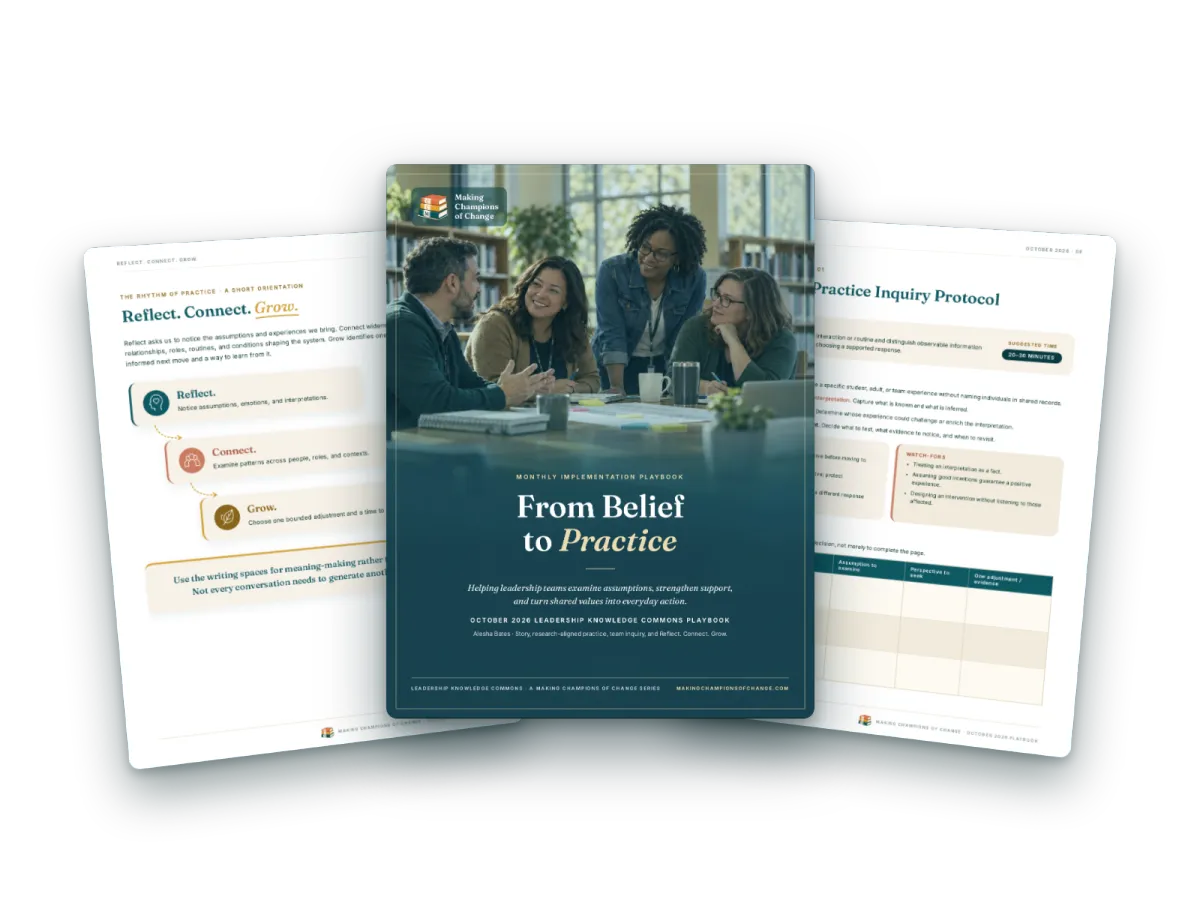
Bring This Entry to
Your Team
Use the Belief-to-Practice Inquiry Protocol to help your team separate what you saw from what you assumed, then plan one supported change with Reflect. Connect. Grow. prompts.
Talk it through with us.
Bring us the work your team is carrying. If you want another perspective on a priority, challenge, or implementation question, we can help you think through what makes sense next.
Before You Go
Think about one idea from this entry that connects to the work in front of you.
What is one thing worth noticing, discussing, or doing differently because of it?
Reflect: What stood out to you in this entry?
Connect: Where do you see this showing up in your own team or system?
Grow: What is one next step worth trying, discussing, or revisiting?
Before You Go
Think about one idea from this entry that connects to the work in front of you.
What is one thing worth noticing, discussing, or doing differently because of it?
Reflect: What stood out to you in this entry?
Connect: Where do you see this showing up in your own team or system?
Grow: What is one next step worth trying, discussing, or revisiting?

A leadership and implementation ecosystem helping education leaders turn good ideas into change that lasts.
Explore
Learn with us
Opportunities
Stay in the Conversation
Get new playbooks, leadership tools, and district stories in your inbox.
© 2026 Making Champions of Change. All rights reserved.