
Learning Entry 1: Culture Is What We Practice, Not What We Post
Relationships
Learning Entry 3:
The Practice of Re-Believing -
What Growth Requires
How shared beliefs become consistent practices that students and educators can experience
Alesha Bates · October 15, 2026 · 5-6 min read

A School Where Every Student Was Known
Early in my teaching career, I worked in an elementary school serving students and families experiencing significant challenges. We had considerable student turnover and students arriving with circumstances that required thoughtful support. Our administrator believed deeply in our ability to make a difference and helped us make that commitment visible.
Together, we worked toward a school where every student was known by name throughout the building. We developed common language and shared expectations. It didn't happen all at once; people started in different places and learned together. What stays with me isn't a particular lesson or program. It's the experience of a team turning shared purpose into everyday practice.
The Difference Between Commitment and Implementation
I've participated in meetings full of educators who care deeply about improving student outcomes. Then the conversation turns to implementation: Who is responsible? Where are the resources? What does the practice look like? How will we know whether it is happening?
I remember mornings as a teacher when I needed a lesson on a social skill because of something that had happened the previous day. I knew what I wanted to teach, but finding and adapting a resource took time. That experience helped shape SEL Blueprint. I wanted educators to have practical resources they could access when they needed them.
But resources are only one part of implementation. Durlak and colleagues (2011), in a meta-analysis of 213 school-based social-emotional learning programs, found positive student outcomes and identified implementation quality as an important factor. Knowing that a practice is research-supported doesn't mean educators have the conditions to use it well.
Shared Language Creates Opportunities for Shared Practice
In our elementary school, students could encounter recognizable expectations across classrooms and settings. Imagine a social-emotional skill introduced in class and reinforced in hallways, during lunch, and in the next grade. That continuity requires participation from paraprofessionals, food service staff, custodians, office staff, administrators, and other adults who shape the school day.
Bryk and Schneider (2002) describe relational trust as a resource for school improvement. Common language alone doesn't create trust, but developing practices together and recognizing each person's contribution can make shared commitments visible. Adults need to understand the purpose and experience support in their own roles.
Consistency Does Not Mean Every Classroom
Looks the Same
Every classroom and district has its own circumstances. When we work with schools through SEL Blueprint, I don't expect every educator to use a workbook in exactly the same way. One classroom may need more attention to collaboration; another may need support with emotional regulation. Consistency means understanding shared outcomes and preserving essential elements while adapting to student needs.
Weiner's (2009) readiness framework reminds us that shared commitment and collective capability are distinct. Teams need to determine what stays consistent, where adaptation is appropriate, and how they will learn from implementation. A common resource library, clear routines, and opportunities to learn across grades help transform individual effort into organizational capacity.
Re-believing isn't repeatedly convincing ourselves that an initiative matters. It's continuing to learn how to make that belief visible in practice.
A Shared-Practice Implementation Check
| Examine | Ask | Possible move |
|---|---|---|
| Purpose | Can everyone explain what we are improving? | Describe the intended outcome. |
| Language | Will students hear recognizable terms? | Model essential language across roles. |
| Resources | Can educators find what they need? | Organize accessible tools and practice. |
| Adaptation | What stays consistent and what can vary? | Identify essentials and adaptations. |
| Learning | How will we know what is happening? | Review experiences and evidence regularly. |
Reflect. Connect. Grow.
Reflect. Where is there a gap between a belief and your daily practice?
Connect. Who shapes students’ experiences but is missing from implementation conversations?
Grow. Select one practice and identify language, resources, and feedback routines.
References
Bryk, A. S., & Schneider, B. (2002). Trust in schools: A core resource for improvement. Russell Sage Foundation.
Durlak, J. A., et al. (2011). The impact of enhancing students’ social and emotional learning: A meta-analysis of school-based universal interventions. Child Development, 82(1), 405–432. https://doi.org/10.1111/j.1467-8624.2010.01564.x
Weiner, B. J. (2009). A theory of organizational readiness for change. Implementation Science, 4, 67.
Explore More In this series
Entry 3 · The Practice of Re-Believing -What Growth Requires
Coming soon
Entry 4 · Leading with Hope - The Case for Optimistic Systems
Coming soon
Entry 5 · Belief to Practice - Staying in
the Struggle
Bring This Entry to
Your Team
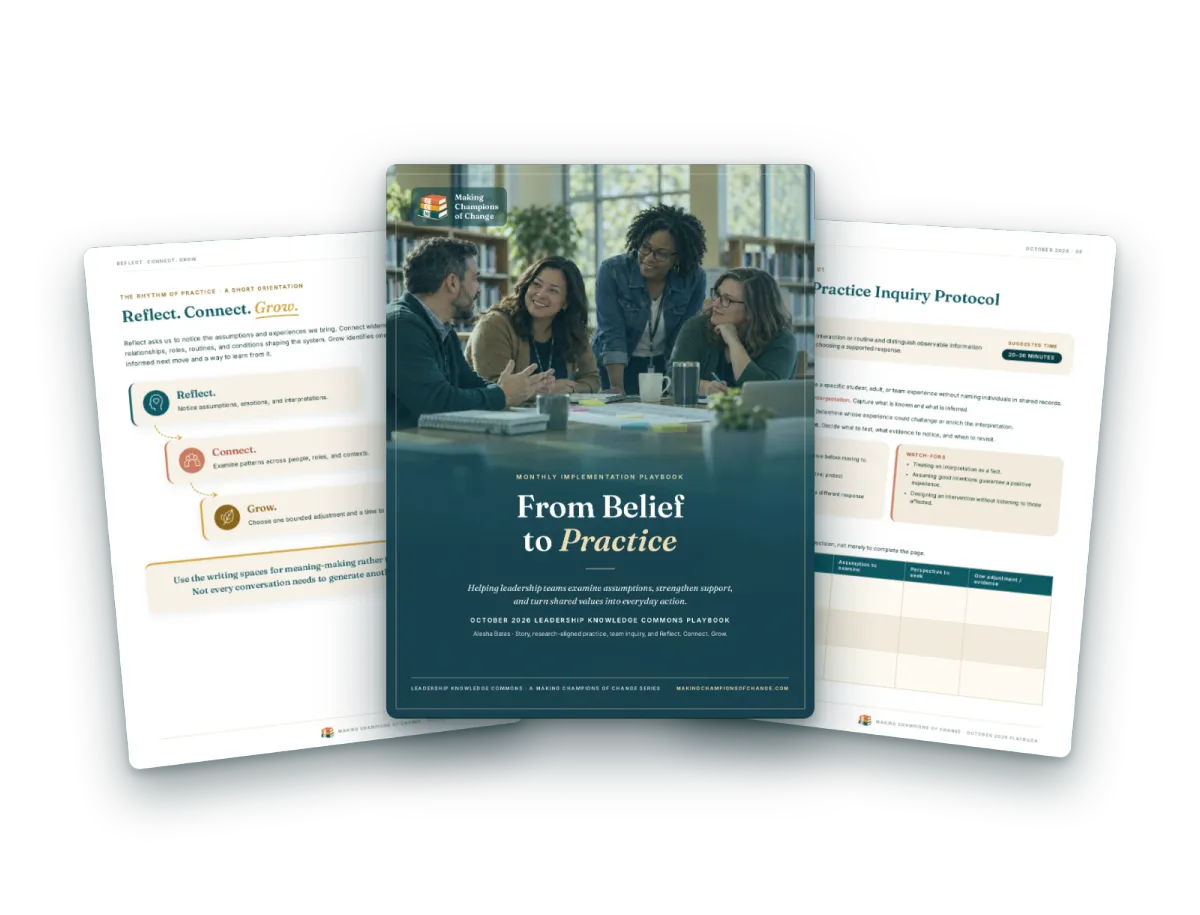
Use the Belief-to-Practice Inquiry Protocol to help your team separate what you saw from what you assumed, then plan one supported change with Reflect. Connect. Grow. prompts.
Talk it through with us.
Bring us the work your team is carrying. If you want another perspective on a priority, challenge, or implementation question, we can help you think through what makes sense next.
Before You Go
Think about one idea from this entry that connects to the work in front of you.
What is one thing worth noticing, discussing, or doing differently because of it?
Reflect: What stood out to you in this entry?
Connect: Where do you see this showing up in your own team or system?
Grow: What is one next step worth trying, discussing, or revisiting?

A leadership and implementation ecosystem helping education leaders turn good ideas into change that lasts.
Explore
Learn with us
Opportunities
Stay in the Conversation
Get new playbooks, leadership tools, and district stories in your inbox.
© 2026 Making Champions of Change. All rights reserved.