
Learning Entry 1: Culture Is What We Practice, Not What We Post
Relationships
Learning Entry 2: Interrupting Limiting Beliefs in Ourselves and Teams
Why changing expectations requires more than asking people to think differently
Alesha Bates · October 08, 2026 · 6-7 min read
The Possibilities Someone Else Saw in Me
I didn't always believe I could become an educator. I received special education services through elementary, middle, and high school, and those experiences influenced what I believed about my own abilities. I spent ten years as a hairstylist, work I loved because of the relationships I developed with clients. But I continued feeling that I wanted to contribute in another way. Encouraged by my husband, I applied for a paraprofessional position supporting students with developmental disabilities. That decision changed my professional journey.
Looking back, I recognize the importance of people who believed in possibilities I hadn't imagined for myself. My third-grade teacher and principal provided that encouragement when I was younger. Their example still influences the expectations I establish for students.
When Support Becomes an Unintended Limitation
I remember starting a position and learning that a student couldn't go outside with his peers because of difficulties he'd experienced. I questioned that conclusion. What was preventing him from participating? What supports might make it possible? I wasn't suggesting we ignore his needs. I wanted us to consider whether we had moved too quickly from identifying a challenge to eliminating an opportunity.
When we repeatedly communicate what students cannot do, we risk influencing what they believe is possible. Yet encouragement alone cannot replace instruction, accommodations, and appropriate planning. Yeager and Walton (2011) emphasize that belief-related interventions depend on context. Our beliefs should expand the possibilities we investigate, not replace the work needed to make participation successful.
The Discomfort of Challenging a Colleague
I've worked with educators whose perspectives differed from mine, including expectations for students receiving special education services. Earlier in my career, I sometimes wondered why experienced educators weren't more willing to try something different. With time, I've learned that I didn't always understand their perspectives, either. The purpose of a difficult conversation should not be proving which adult is right; it should be understanding what the student needs.
Edmondson (1999) found that team psychological safety was associated with learning behavior. Although her study was not conducted in schools, it offers a useful organizational lens. If challenging assumptions produces embarrassment or defensiveness, people may stop speaking. If uncertainty becomes an opportunity for inquiry, different perspectives can become useful information.
Not Every Implementation Barrier Is a Belief Problem
Through SEL Blueprint, I've met educators who care deeply about improving student experiences but struggle to move from discussion to action. Who will do the work? Where are the resources? How does another responsibility fit? Sometimes apparent resistance is uncertainty about the steps involved. Sometimes it is a lack of time or tools; sometimes there is genuine disagreement. Those situations require different responses.
Weiner (2009) distinguishes shared commitment to change from shared confidence in an organization's capability to carry it out. Before asking people to change their mindset, leaders should examine the conditions influencing their ability to act. I would rather invite someone to try one small piece of a new practice, examine what happens, and learn together than demand immediate agreement.
We interrupt limiting beliefs most meaningfully when we pair new possibilities with the relationships, evidence, and practical support needed to explore them.
A Limiting-Belief Inquiry
| Examine | Ask | Possible move |
|---|---|---|
| Student cannot do that | What support would make participation possible? | Design a supported opportunity. |
| We have always done it this way | What has worked, and what has changed? | Test one adjustment. |
| Staff will not implement this | What barriers are staff experiencing? | Gather implementation feedback. |
| We lack capacity | What would make this manageable? | Clarify priorities and resources. |
Reflect. Connect. Grow.
Reflect. What belief about your abilities has changed, and who helped?
Connect. Where might your team be treating a current limitation as permanent?
Grow. Design one small supported test before making a long-term decision.
References
Edmondson, A. (1999). Psychological safety and learning behavior in work teams. Administrative Science Quarterly, 44(2), 350–383. https://doi.org/10.2307/2666999
Weiner, B. J. (2009). A theory of organizational readiness for change. Implementation Science, 4, 67. https://doi.org/10.1186/1748-5908-4-67
Yeager, D. S., & Walton, G. M. (2011). Social-psychological interventions in education: They’re not magic. Review of Educational Research, 81(2), 267–301.
Explore More In this series
Entry 2 · Interrupting Limiting Beliefs in Ourselves and Teams
Coming soon
Entry 4 · Leading with Hope - The Case for Optimistic Systems
Coming soon
Entry 5 · Belief to Practice - Staying in
the Struggle
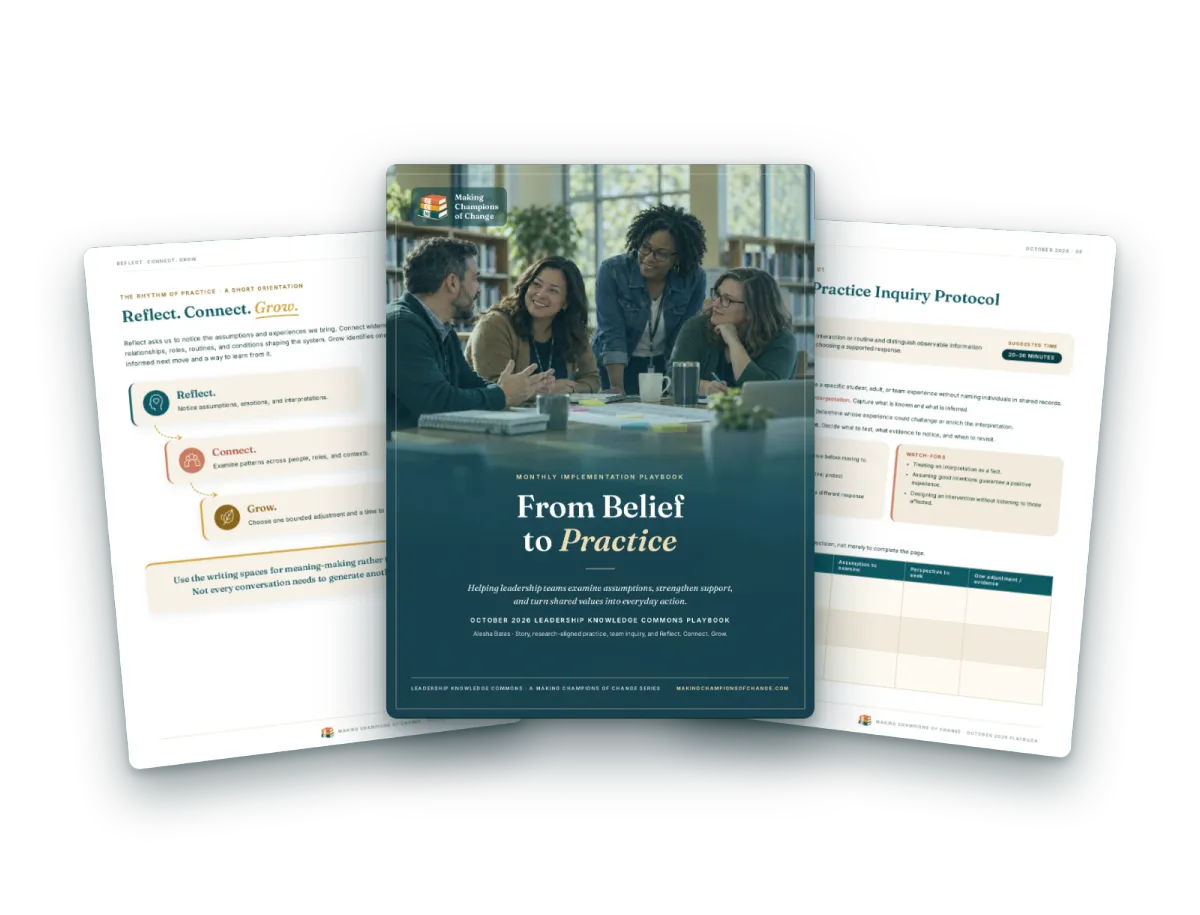
Bring This Entry to
Your Team
Use the Belief-to-Practice Inquiry Protocol to help your team separate what you saw from what you assumed, then plan one supported change with Reflect. Connect. Grow. prompts.
Talk it through with us.
Bring us the work your team is carrying. If you want another perspective on a priority, challenge, or implementation question, we can help you think through what makes sense next.
Before You Go
Think about one idea from this entry that connects to the work in front of you.
What is one thing worth noticing, discussing, or doing differently because of it?
Reflect: What stood out to you in this entry?
Connect: Where do you see this showing up in your own team or system?
Grow: What is one next step worth trying, discussing, or revisiting?

A leadership and implementation ecosystem helping education leaders turn good ideas into change that lasts.
Explore
Learn with us
Opportunities
Stay in the Conversation
Get new playbooks, leadership tools, and district stories in your inbox.
© 2026 Making Champions of Change. All rights reserved.