
Learning Entry 1: Culture Is What We Practice, Not What We Post
Relationships
Learning Entry 1: Culture Is What We Practice, Not What We Post
How everyday routines teach people what a school really values
Joe Jezierski · September 03, 2026 · 8 min read
A Story I Understand Differently Now
When I look back across more than 30 years in education, I can see a throughline that I did not recognize while I was living it. I did not enter education through a straight path. I was going to be an attorney. I was working in a school district during the day and attending law school at night when I realized how much I loved working with students. I began as a level-three EBD paraprofessional, returned for my teaching license, and eventually became an English teacher. At the time, I thought my work was mostly about teaching English. Looking back, I can see that I was paying attention to something else just as closely: whether students felt connected enough to learn.
I remember a significant incident in one of my schools in which a student of color was attacked by other students. A couple of weeks later, I could feel the rumblings of it in my classroom. I stopped what I had planned and we spent each class period talking about how they felt and what they could do. No one had directed me to do that, and I did not yet have the language of school climate and culture that I have now to describe why I did it. I simply knew that what students were carrying into the room mattered to what could happen in the room.
Culture Lives in Repeated Experience
That experience still shapes how I think about culture. Culture is not primarily a statement on a wall or on a website. It is the set of assumptions, norms, routines, and interactions people repeatedly experience. Organizational scholarship distinguishes between culture—the deeper values and assumptions operating within an organization—and climate—the shared meanings people attach to what they experience there (Schneider et al., 2013). In schools, those meanings are built in ordinary moments: who is welcomed, whose concerns are acted on, how predictable adult responses are, and whether the stated values of the school remain visible when pressure rises.
As a leader, I began to notice the difference between formal and informal culture. Formal culture is easier to see. It lives in policy, handbooks, schedules, mission statements, and written procedures. Informal culture often lives in the phrase, “this is just how we do things here.” Both matter because both teach people what to expect.
One example was small but instructive. In one school, we had a tradition of decorating doors for Christmas. The activity itself was good for connection, but we were also saying that all students and families were welcome while centering one religious tradition in a shared school activity. We shifted the theme to winter. The relational purpose stayed intact, while the practice better matched the value we said we held.
I have also seen the stakes become much higher. I worked with a superintendent who began using paid administrative leave while serious concerns were investigated. Because the practice had not previously been used consistently or clearly explained, staff could experience leave as punishment. The leadership task was not simply deciding whether the procedure was appropriate. We needed to make the process understandable and predictable. Predictability matters for adults, too.
Evidence-Based Culture Practices Leaders Can Use
Research on school improvement consistently places relational trust, purposeful communication, and leader attention to staff experience near the center of sustainable culture work. Hollingworth and colleagues (2018), for example, found that principals in improving schools built culture through knowing staff, initiating conversations, creating trust, and opening opportunities for participation. The implication is practical: culture is strengthened less by naming more values and more by designing routines that make those values visible.
I have learned to look for three places where culture becomes especially observable. First, look at transitions and moments of uncertainty: arrival, dismissal, the lunchroom, staff changes, conflict, investigations, schedule changes, and the start of new initiatives. Second, look at workarounds. A workaround may be a creative solution, but repeated workarounds can also signal that a formal system is unclear, burdensome, or out of alignment with stated expectations. Third, look for positive outliers. Which classrooms, teams, or roles seem to create unusually strong belonging, calm, or trust? Instead of treating those successes as personality, study the practices that make them possible.
This is where leaders can move from “culture work” as an abstract goal to culture as an observable practice. A leader can walk a system and ask: What do people have to guess here? Who has to compensate? Which experiences are predictable in a good way? Where is our language stronger than our practice? Those questions produce information that a climate slogan cannot.
Another practice I have found useful is to make culture visible in the same places we already review instruction and operations. A leadership team can take ten minutes in a standing meeting to name one cultural signal: a pattern in family communication, a student transition that is working well, a repeated staff workaround, or a moment where a policy was experienced differently than intended. The point is not to score culture. It is to keep lived experience close enough to decision making that the team can respond before a small pattern becomes “just how things are.”
If people watched what we repeatedly do, what would they conclude that we value?
A Simple Culture Practice Scan
| Look for | Ask | Possible leader move |
|---|---|---|
| Predictability | Do people know what happens next when something goes wrong? | Clarify and communicate the routine before the next incident. |
| Informal workarounds | What are people doing “off the books” to make the system work? | Determine whether the workaround reveals a design gap. |
| Positive outliers | Where are belonging and trust unusually strong? | Study the practice and make it learnable by others. |
| Value-practice gaps | Where does lived experience contradict stated values? | Change one routine so the experience better matches the value. |
Reflect. Connect. Grow.
Reflect. Where does your own behavior most clearly communicate what you value? When pressure rises, where might your actions send a different message?
Connect. Where do written expectations and lived experience align? Where do informal routines, exceptions, or workarounds shape culture more strongly than policy?
Grow. Choose one ordinary practice to examine with others. Ask what it communicates, who experiences it differently, and one change that would bring the practice closer to the value.
References
Hollingworth, L., Olsen, D., Asikin-Garmager, A., & Winn, K. M. (2018). Initiating conversations and opening doors: How principals establish a positive building culture to sustain school improvement efforts. Educational Management Administration & Leadership, 46(6), 1014–1034. https://doi.org/10.1177/1741143217720461
Schneider, B., Ehrhart, M. G., & Macey, W. H. (2013). Organizational climate and culture. Annual Review of Psychology, 64, 361–388. https://doi.org/10.1146/annurev-psych-113011-143809
Take it to Your Team
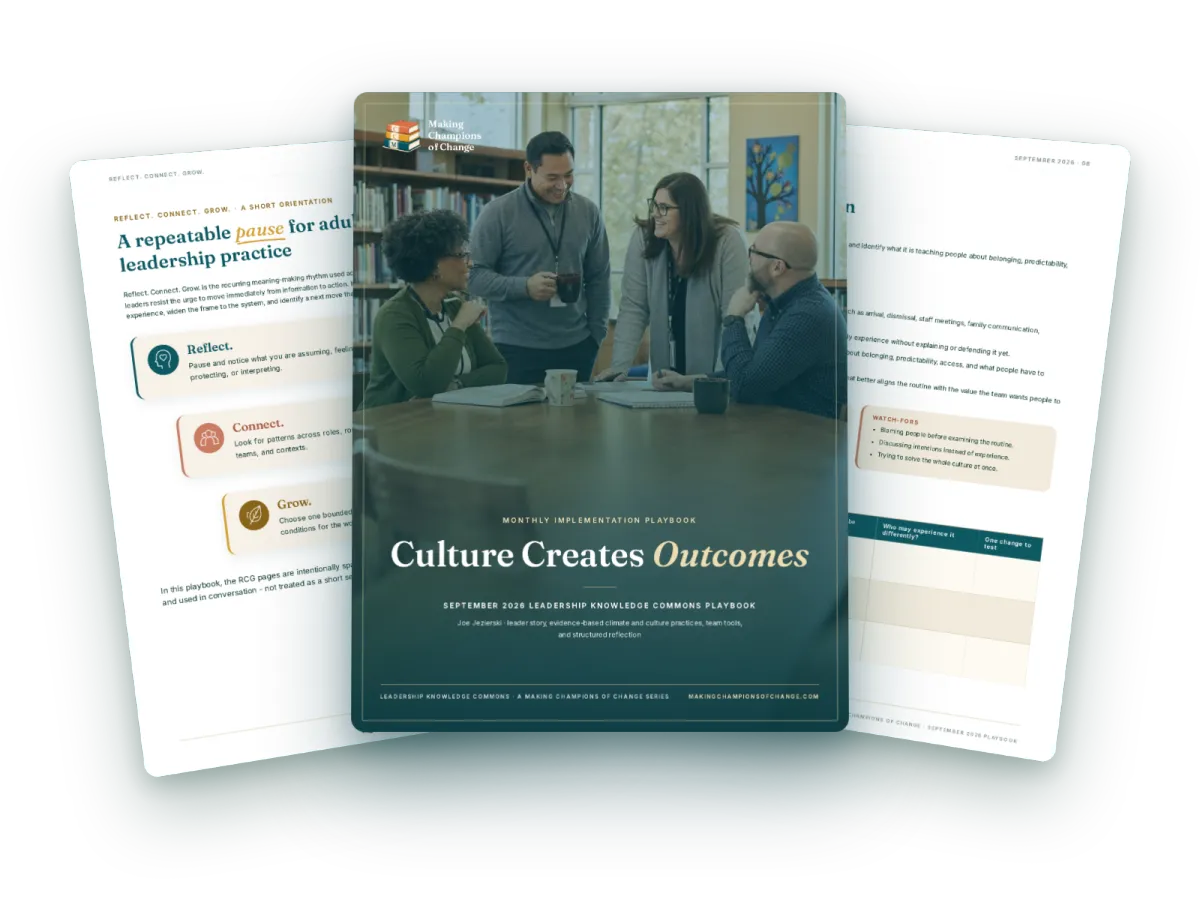
Turn the ideas from this series into a practical team conversation with Culture Creates Outcomes, a playbook of tools, worksheets, and Reflect. Connect. Grow. prompts designed for application.
Talk it through with us.
Bring us the work your team is carrying. If you want another perspective on a priority, challenge, or implementation question, we can help you think through what makes sense next.
Before You Go
Think about one idea from this entry that connects to the work in front of you.
What is one thing worth noticing, discussing, or doing differently because of it?
Reflect: What stood out to you in this entry?
Connect: Where do you see this showing up in your own team or system?
Grow: What is one next step worth trying, discussing, or revisiting?
Before You Go
Think about one idea from this entry that connects to the work in front of you.
What is one thing worth noticing, discussing, or doing differently because of it?
Reflect: What stood out to you in this entry?
Connect: Where do you see this showing up in your own team or system?
Grow: What is one next step worth trying, discussing, or revisiting?

A leadership and implementation ecosystem helping education leaders turn good ideas into change that lasts.
Explore
Learn with us
Opportunities
Stay in the Conversation
Get new playbooks, leadership tools, and district stories in your inbox.
© 2026 Making Champions of Change. All rights reserved.