
Learning Entry 1: Culture Is What We Practice, Not What We Post
Relationships
Learning Entry 4: Sustaining Connection Through the Hard Middle of the Year
How climate and culture practices become part of the system instead of depending on a heroic leader
Joe Jezierski · September 17, 2026 · 7-8 min read
A Pilot That Became “How We Do Things Here”
When I think about sustainability, one of the best examples from my career is student-led conferences. Before I became an assistant principal in one school, a small group of teachers became interested in changing the traditional conference model. There were roughly six people in a staff of about 50 who were initially passionate about the idea. That was not a mandate, and it was not yet a tipping point.
What mattered was what happened next. One grade level piloted student-led conferences, and they conducted an actual pilot. They collected information before and after. They asked families about the experience. They examined what worked and what did not. The assumption was not, “You are piloting it this year, so everyone will do it next year.” The assumption was: we are going to learn whether this is worth carrying forward and what it would take to do it well.
By the time I arrived, the practice was expanding. As a new assistant principal, I did not have to drive it. Teachers were leading the work. Years later, as far as I know, the school was still using student-led conferences across multiple principal transitions. Families came to expect the model because older siblings had experienced it. The practice had moved from an initiative to part of how the school understood conferences.
Sustainability Is More Than Duration
That is what sustainability looks like to me. It is not simply doing something for a long time. It is building enough shared purpose, skill, clarity, ownership, and feedback that the practice can continue without depending on the person who originally pushed it.
Relational trust is part of that infrastructure. Bryk and Schneider’s (2002) work in Chicago schools positioned relational trust as a core resource for improvement because it supports the willingness of adults to work together, take risks, and engage in change. Research on principals sustaining school improvement also points to trust, purposeful communication, and knowing staff well as important leadership practices (Hollingworth et al., 2018). Implementation research adds another layer: readiness depends not only on whether people value a change but also whether they believe the organization has the collective capability to carry it (Weiner, 2009).
These findings fit what I have experienced. A good practice needs relationships strong enough for honest feedback, routines clear enough for people to use, and capacity broad enough that the work is not housed in one person.
The Heroic Leader Test
This is where I become cautious about heroic leadership. I work with leaders who are remarkable at creating relationships. Some know every family, respond personally to every crisis, and hold a complex school together through energy and commitment. That can create meaningful change. But I keep asking: is this a system change or a you change?
If the principal has strong relationships with families, who else does? If the leader leaves, what remains? If the process only exists in one person’s memory, is it actually part of the organization? Heroic effort may help start the flywheel. Sustainability requires the flywheel to keep moving when the hero is not pushing it.
Practices for the Hard Middle
The same question matters in the hard middle of a school year. Connection is easy to prioritize at kickoff. It is harder in November, February, or any season when energy drops and the work has become routine. That is when systems discover whether connection was an event or an infrastructure.
I encourage leaders to revisit a few implementation questions in the middle, not only at launch. Do people still know why we are doing this? Can new staff learn the practice without locating the original champion? Do teams have a regular way to talk about what is working and what is getting in the way? Are we examining implementation evidence, not only outcomes? Have we added new expectations before the current practice stabilized?
A particularly useful sustainability practice is distributed ownership. Identify who can teach the practice, who can monitor it, who can explain the purpose, and who can adapt it when conditions change. If all four answers point to the same person, the system is fragile. Another useful move is a short midyear fidelity conversation focused on learning rather than compliance: What are we still doing consistently? Where has variation emerged? Which variation is healthy adaptation, and which signals that the practice is slipping?
The question I keep returning to is simple: if I disappeared from this work tomorrow, what would still know how to happen? The answer tells me whether I built a program around myself or helped build a system.
One way to test that is to ask someone who did not help design the initiative to explain it. Can they describe the purpose, the core practice, where to find support, and what to do when the practice does not fit perfectly? If not, the system may still be relying on insider knowledge. Sustainability improves when the work is understandable to the next person, not only familiar to the people who were there at the beginning.
Sustainability is not the absence of change. It is the ability to keep learning without losing what matters.
A Midyear Sustainability Check
| Check | Evidence to look for | Possible move |
|---|---|---|
| Purpose | Can people still explain why the practice matters? | Reconnect the practice to the problem it was meant to address. |
| Ownership | Who can teach or lead it besides the original champion? | Distribute facilitation, coaching, or monitoring roles. |
| Use | Is the practice still occurring as intended? | Review implementation evidence and distinguish adaptation from drift. |
| Learning | How does the system learn from what is happening? | Build a regular feedback loop and make one adjustment at a time. |
Reflect. Connect. Grow.
Reflect. What part of your leadership currently depends too heavily on you? What would become fragile if you stepped away?
Connect. What has become genuinely embedded, and what is still being held together by one or two people? Where has the original purpose or consistency faded?
Grow. Choose one practice worth sustaining. Transfer one piece of ownership from a person to the system by documenting it, teaching it, building a feedback loop, or bringing another leader into the work.
References
Bryk, A. S., & Schneider, B. (2002). Trust in schools: A core resource for improvement. Russell Sage Foundation.
Hollingworth, L., Olsen, D., Asikin-Garmager, A., & Winn, K. M. (2018). Initiating conversations and opening doors: How principals establish a positive building culture to sustain school improvement efforts. Educational Management Administration & Leadership, 46(6), 1014–1034. https://doi.org/10.1177/1741143217720461
Weiner, B. J. (2009). A theory of organizational readiness for change. Implementation Science, 4, 67. https://doi.org/10.1186/1748-5908-4-67
Explore More In this series
Entry 4 · Sustaining Connection Through the Hard Middle of the Year
Take it to Your Team
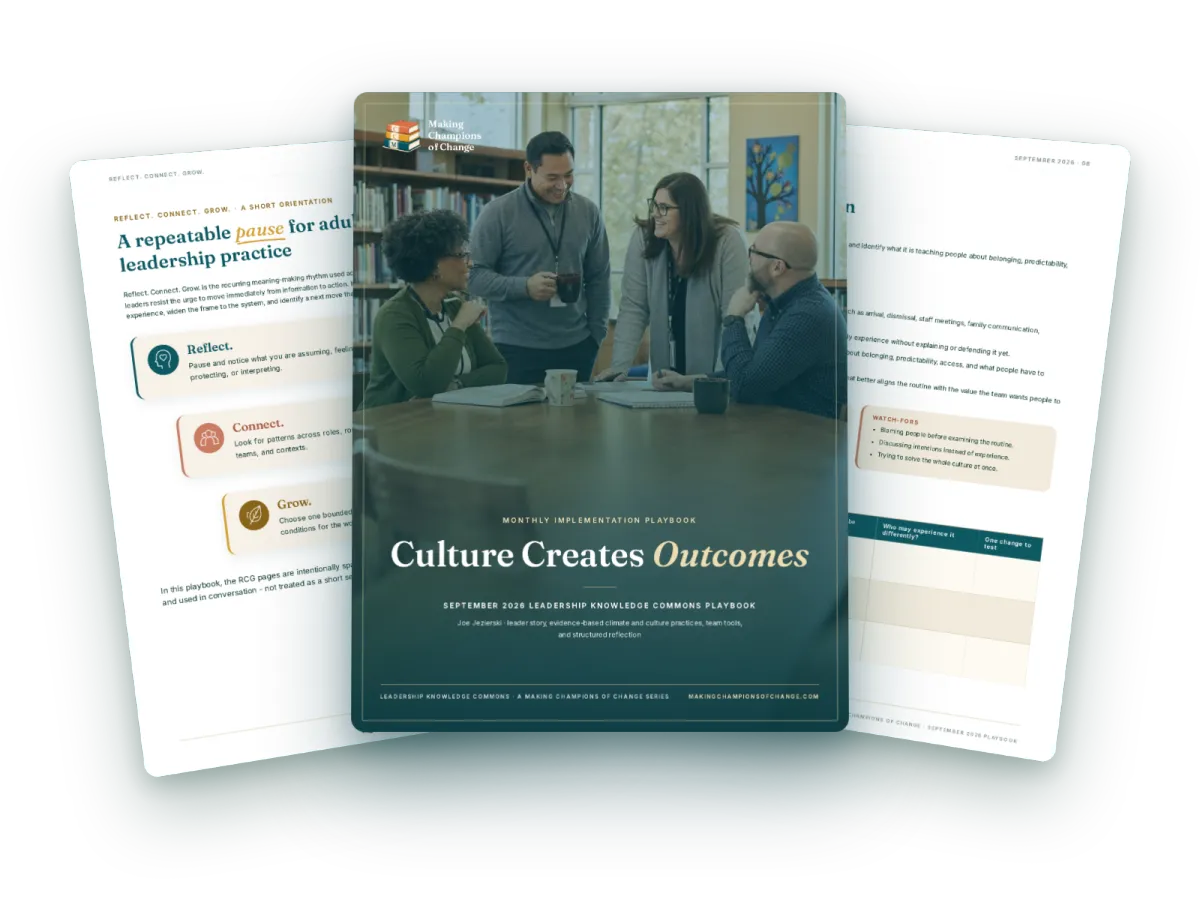
Turn the ideas from this series into a practical team conversation with Culture Creates Outcomes, a playbook of tools, worksheets, and Reflect. Connect. Grow. prompts designed for application.
Talk it through with us.
Bring us the work your team is carrying. If you want another perspective on a priority, challenge, or implementation question, we can help you think through what makes sense next.
Before You Go
Think about one idea from this entry that connects to the work in front of you.
What is one thing worth noticing, discussing, or doing differently because of it?
Reflect: What stood out to you in this entry?
Connect: Where do you see this showing up in your own team or system?
Grow: What is one next step worth trying, discussing, or revisiting?
Before You Go
Think about one idea from this entry that connects to the work in front of you.
What is one thing worth noticing, discussing, or doing differently because of it?
Reflect: What stood out to you in this entry?
Connect: Where do you see this showing up in your own team or system?
Grow: What is one next step worth trying, discussing, or revisiting?

A leadership and implementation ecosystem helping education leaders turn good ideas into change that lasts.
Explore
Learn with us
Opportunities
Stay in the Conversation
Get new playbooks, leadership tools, and district stories in your inbox.
© 2026 Making Champions of Change. All rights reserved.