


Turn your fall data into a plan
Start with a free 30-minute team review to name your priority students before winter break.
Learning Entry 1: Culture Is What We Practice, Not What We Post
Relationships
Part 3: Fidelity as Information, Not Indictment
Dr. Morgan Goering · November 19, 2026 · 6-7 min read
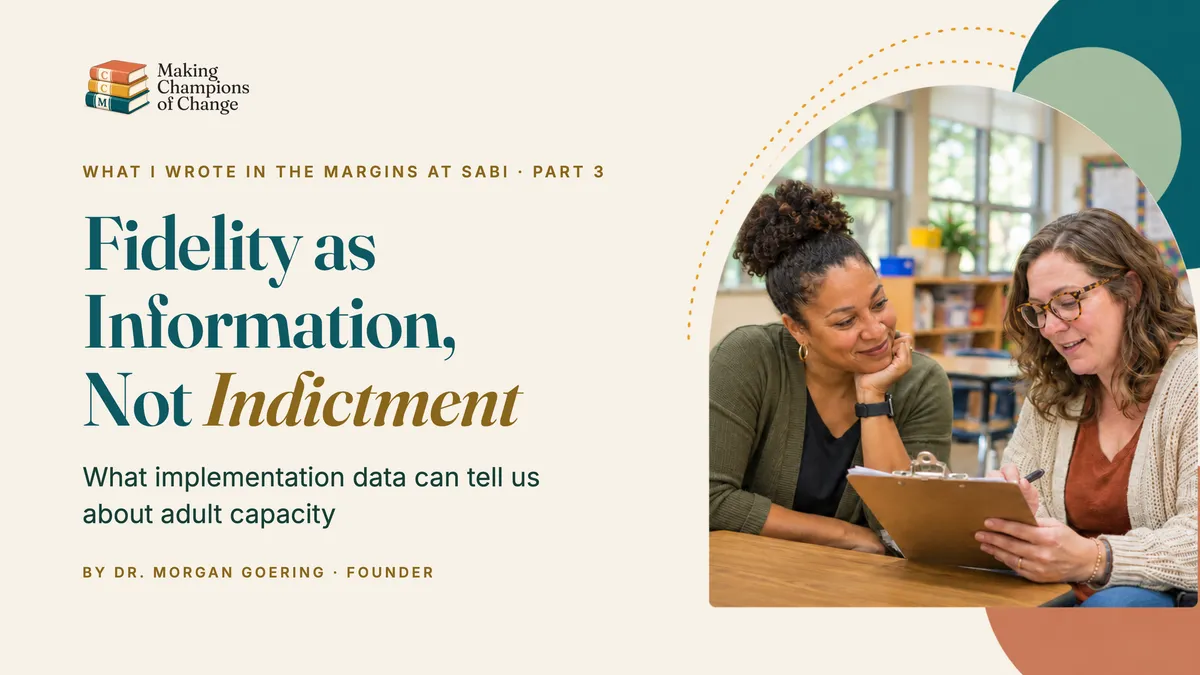

What implementation data can tell us about adult capacity
Grounding Wonder: What might change if fidelity data were used not only to determine whether adults are implementing a practice, but also to understand what adults need in order to implement it well?
One of the more important connections I wrote at SABI was short enough to fit in a margin: Fidelity → Adult Capacity → Act of Care + Support.
I have returned to that sequence repeatedly because fidelity carries considerable baggage in organizational life.
When practitioners hear the word, they may imagine observation forms, compliance checks, implementation percentages, or another mechanism through which leadership determines whether someone has done the work correctly. In systems where measurement has historically been experienced as judgment, this response is understandable.
Yet fidelity is not inherently punitive. It is information about implementation.
Dane and Schneider (1998), in an early review of program integrity, demonstrated why this information matters: many prevention studies failed to adequately document implementation integrity, making it difficult to determine whether weak outcomes reflected limitations in the intervention or weaknesses in its delivery. Durlak and DuPre (2008) later reinforced the broader relationship between implementation quality and program outcomes. Proctor et al. (2011) formalized fidelity as one of several distinct implementation outcomes, alongside constructs such as acceptability, feasibility, adoption, and sustainability.
Taken together, this literature offers a more productive interpretation of fidelity than simple compliance.
If a practice is not occurring as intended, leaders have learned something important. They have not yet learned why.
That distinction should shape the next conversation.
Low fidelity may indicate insufficient understanding. It may reflect an intervention that is too complex for existing routines. Adults may have received conceptual professional learning but insufficient rehearsal. The practice may conflict with a legacy procedure that was never retired. Competing initiatives may be consuming the same time and attention. Coaching may be inconsistent. Staff turnover may have introduced people who never received the original learning. The intervention may require thoughtful contextual adaptation. Leadership may believe an expectation is clear while teams have constructed multiple interpretations of what “good implementation” looks like.
None of these explanations automatically removes individual responsibility. They make responsibility more precise.
If we do not investigate implementation context, fidelity data can easily become a conclusion when it should have been the beginning of inquiry.
This is particularly important because implementation quality is not produced solely by the practitioner. Domitrovich et al. (2008) conceptualized school implementation as a multilevel process in which characteristics of the intervention, provider, school, and broader support system interact. Durlak and DuPre (2008) similarly identified provider characteristics, organizational functioning, training, and technical assistance among the influences on implementation.
A fidelity problem may therefore be a provider issue. It may also be a system signal.
This is where the MCC Five Pillars create a useful analytic pause.
Under Conditions, we might ask whether schedules, policies, priorities, and resources make the practice feasible. Under Relationships, we might examine whether people have access to trusted coaching, collaborative problem solving, and leadership support. Under Practices, we ask whether the expected behaviors are sufficiently concrete to be observed, modeled, rehearsed, and discussed. Under Capacity, we consider knowledge, skill, time, confidence, feedback, and distributed leadership. Under Sustainability, we ask whether the organization is building infrastructure that can continue supporting the practice after initial implementation attention recedes.
When leaders read fidelity data through those pillars, accountability becomes more reciprocal.
Practitioners remain accountable for engaging seriously with agreed-upon practices. The organization becomes accountable for creating reasonable conditions in which those practices can be learned and enacted.
This is what I meant when I wrote act of care + support. Care does not mean avoiding difficult evidence. It means refusing to use evidence more simplistically than it deserves.
Consider a district that expects educators to use a particular relational or instructional practice consistently. After several months, observation suggests that only half of staff are doing so reliably. A compliance-oriented response begins with the 50 percent who are “not doing it.” An implementation-oriented response begins with the system.
What did the original learning actually prepare people to do? What examples were modeled? What opportunities existed for practice? How often did feedback occur? Were expectations interpreted consistently across buildings? Did leaders make time for the work? What barriers appeared only after implementation began? Are adults adapting the practice? If so, which adaptations protect the intended function and which remove essential components? What have successful implementers figured out that the organization has not yet made visible to everyone else?
Those questions produce more actionable information than a reminder email. They also protect leaders from assuming that variation reflects motivation when it may reflect capacity.
There is another reason this matters. If fidelity data are experienced primarily as surveillance, adults have strong incentives to make implementation appear more consistent than it is. A system can then produce cleaner dashboards while losing access to the very learning the data were supposed to create.
The goal is not to make fidelity comfortable. The goal is to make it useful.
Strong implementation requires enough psychological safety for people to say, “This part is not working,” “I am not yet confident doing this,” or “The way we designed this does not fit what is happening in practice.” Those statements are not necessarily evidence of failure. They may be the information the system needs in order to improve.
The margin note I carried away from SABI therefore represents a shift in sequencing: measure → interpret → support → learn → adjust. Not: measure → judge.
Fidelity deserves rigor because implementation matters. People deserve care because implementation is carried by human beings. The two commitments are not contradictory. They are what allow an organization to become more precise about both expectations and support.
Reflect. Connect. Grow.
Reflect: Think about the last time your organization reviewed implementation data. Did the conversation begin with curiosity about what the evidence might mean, or with an assumption about why people were not meeting expectations?
Connect: Where might current fidelity variation be connected to Conditions, Relationships, Practices, Capacity, or Sustainability? What organizational explanation has not yet been investigated because the variation has been framed primarily as an individual performance issue?
Grow: Choose one implementation measure and redesign the conversation around it. What question could help the team move from “Who is doing this?” toward “What are we learning about what it takes to do this well?”
References
Dane, A. V., & Schneider, B. H. (1998). Program integrity in primary and early secondary prevention: Are implementation effects out of control? Clinical Psychology Review, 18(1), 23–45.
Domitrovich, C. E., Bradshaw, C. P., Poduska, J. M., Hoagwood, K., Buckley, J. A., Olin, S., Romanelli, L. H., Leaf, P. J., Greenberg, M. T., & Ialongo, N. S. (2008). Maximizing the implementation quality of evidence-based preventive interventions in schools: A conceptual framework. Advances in School Mental Health Promotion, 1(3), 6–28.
Durlak, J. A., & DuPre, E. P. (2008). Implementation matters: A review of research on the influence of implementation on program outcomes and the factors affecting implementation. American Journal of Community Psychology, 41, 327–350.
Proctor, E., Silmere, H., Raghavan, R., Hovmand, P., Aarons, G., Bunger, A., Griffey, R., & Hensley, M. (2011). Outcomes for implementation research: Conceptual distinctions, measurement challenges, and research agenda. Administration and Policy in Mental Health and Mental Health Services Research, 38, 65–76.
Explore More In this series
Part 3 · Fidelity as Information, Not Indictment
Coming Soon
Part 4 · Sustainability Is Not “Keep Doing It”
Coming Soon
Part 5 · Did It Solve the Problem We Chose It to Solve?

Bring This Entry to
Your Team
Use the Fidelity for Learning Toolkit to read implementation gaps with curiosity, sort out clarity, skill, and support issues, and plan the response that fits with Reflect. Connect. Grow. prompts.
Talk it through with us.
Bring us the work your team is carrying. If you want another perspective on a priority, challenge, or implementation question, we can help you think through what makes sense next.
Before You Go
Think about one idea from this entry that connects to the work in front of you.
What is one thing worth noticing, discussing, or doing differently because of it?
Reflect: What stood out to you in this entry?
Connect: Where do you see this showing up in your own team or system?
Grow: What is one next step worth trying, discussing, or revisiting?

A leadership and implementation ecosystem helping education leaders turn good ideas into change that lasts.
Explore
Learn with us
Opportunities
Stay in the Conversation
Get new playbooks, leadership tools, and district stories in your inbox.
© 2026 Making Champions of Change. All rights reserved.