


Turn your fall data into a plan
Start with a free 30-minute team review to name your priority students before winter break.
Learning Entry 1: Culture Is What We Practice, Not What We Post
Relationships
Part 2: Relationships Are Implementation Infrastructure
Dr. Morgan Goering · November 12, 2026 · 8 min read
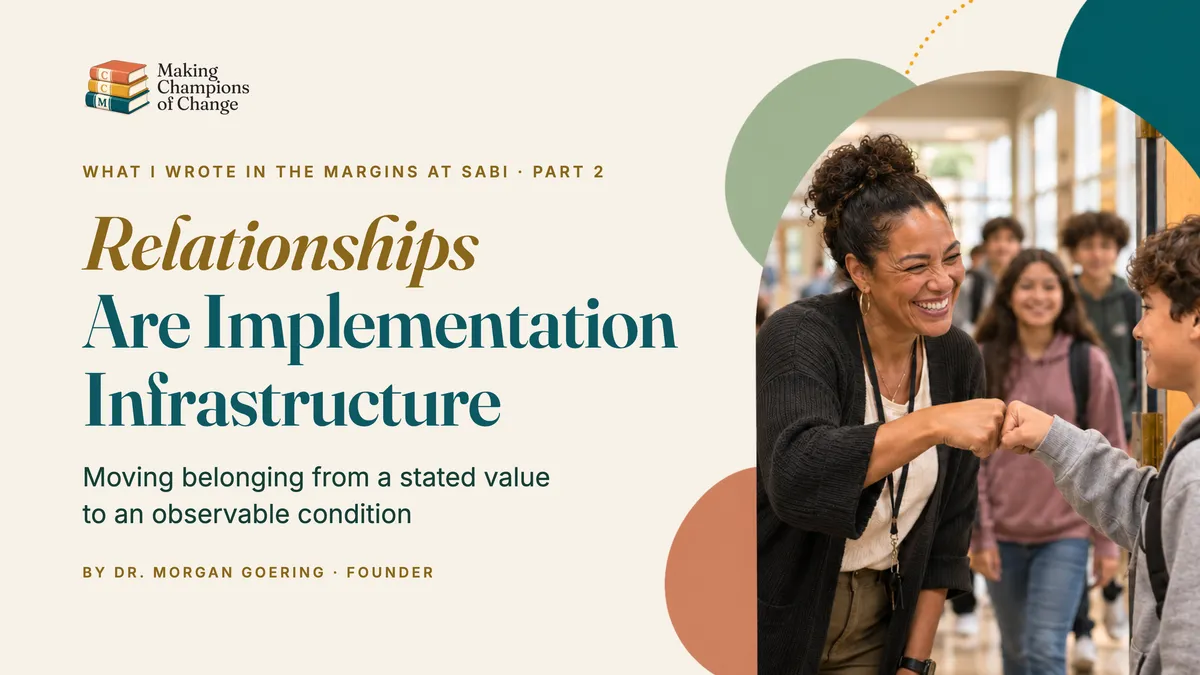

Moving belonging from a stated value to an observable condition
Grounding Wonder: If relationships are central to attendance, engagement, and learning, where should we be able to see that belief operating in the design of the school day?
One of the pages I returned to most often after SABI centered on a deceptively simple practice: 4 at the Door + 1 More. Around it I had written fragments about names, recognition, routines, relationship mapping, and what happens when connection moves from a general belief into an intentional practice.
The simplicity of the practice is important. So is the temptation to underestimate it.
Education has no shortage of language affirming that relationships matter. Mission statements reference belonging. Strategic plans name student connection. Professional learning frequently reminds educators of the importance of knowing students well. Yet an organizational value becomes consequential only when the system translates that value into experiences people can reliably encounter.
The research base supports the importance of doing so. Roorda et al. (2011), in a meta-analysis spanning 99 studies, found meaningful associations between the affective quality of teacher-student relationships and student engagement, with additional associations between relationship quality and academic achievement. Allen et al. (2018), synthesizing research on school belonging, identified teacher support, peer support, environmental safety, and other social and contextual factors as important contributors to students’ sense of belonging. Korpershoek et al. (2020) similarly found that school belonging was associated with motivational, social-emotional, behavioral, and academic outcomes in secondary education, including a small negative association with absence and dropout.
These findings do not mean that relationships function as a singular intervention for complex outcomes such as chronic absenteeism. Attendance can be influenced by transportation, housing, physical health, mental health, family responsibilities, academic experiences, disability, school climate, safety, policy, and numerous factors beyond the immediate control of a school. Treating a greeting routine as a solution to structural barriers would reduce a complex problem to an interpersonal one.
The more useful conclusion is that relational experience is one condition among several that schools can intentionally design.
That distinction matters.
When I wrote Tier 2 relationship mapping in the margin of my workbook, I was not thinking about creating another intervention form. I was considering what happens when we move from believing that every student should have a trusted adult to determining whether that condition actually exists.
Can we identify students whose school experience includes few meaningful adult connections? Do we know whether the adult we identify as “their person” is someone the student would identify the same way? When attendance begins to change, who notices first? When a student returns after a prolonged absence, what relational message is communicated? When students require Tier 2 or Tier 3 support, do increasingly technical intervention structures strengthen human connection or unintentionally replace it?
These questions are especially important in multi-tiered systems because organizational categories can encourage adults to experience students as collections of needs. Attendance lives on one agenda. Behavior lives on another. Academic intervention occurs through another team. Mental health may sit in yet another structure.
The student remains one person.
In my notes I wrote: Not segmented humans. Co-occurring.
That observation has stayed with me because it applies both to students and to systems. A student can simultaneously experience anxiety, academic difficulty, inconsistent attendance, executive-functioning demands, relational disconnection, and strengths that remain largely invisible within problem-focused processes. The existence of multiple needs does not necessarily require multiple disconnected adult responses.
This is one reason relationships function as infrastructure in the MCC Five Pillars rather than as an optional cultural enhancement. Relationships are one of the pathways through which information travels, help is requested, feedback is accepted, ambiguity is surfaced, and people remain engaged when implementation becomes difficult.
The same principle applies to adults.
Implementation moves through relational networks. Formal authority matters, but so do trust, credibility, proximity, informal influence, and shared experience. A technically strong initiative can stall if the people asked to carry it do not trust the process through which it arrived. Conversely, trusted relationships cannot compensate indefinitely for unclear practice, insufficient capacity, or incoherent systems. Relationships are necessary, not sufficient.
This is where Connection First requires more precision than simply “build relationships.” The leadership question becomes: What relational conditions does this work require, and how intentionally have we built them?
For students, that may mean predictable access to adults, relational routines, intentional re-entry after absence, or systematic attention to students whose networks are thin. For adults, it may mean cross-role communication, psychologically safer opportunities to raise concerns, clearer coaching relationships, or intentional use of informal leaders who can help teams interpret a new practice.
The important shift is from relational aspiration to relational design.
A school can value belonging while relying almost entirely on individual educators to create it independently. That creates variability. Some students will experience extraordinary connection. Others may move through the same system largely unseen.
A more mature implementation approach asks where relational practices require enough structure to become dependable without becoming mechanical.
That tension matters. Human connection cannot be standardized in the same way as a procedural checklist. At the same time, leaving connection entirely to chance is not an equity strategy.
The work is therefore to create structures that increase the probability of meaningful connection while preserving the humanity inside them.
A greeting practice can remind adults to notice. A relationship map can reveal a pattern. A check-in routine can create predictable access. A team process can ensure that relational information is considered alongside academic or behavioral data. But the existence of the structure is not proof that the relationship exists.
That distinction brings us back to implementation.
We can count the number of students assigned to mentors. We can document whether a check-in happened. We can monitor participation in a relationship-building practice. We should also remain curious about experience.
Does the student feel known? Does the interaction communicate genuine interest? Does the adult understand what matters to the student beyond the presenting problem? Would the student seek that adult out when something becomes difficult?
Relationships are difficult to reduce to a single metric because they are lived rather than merely delivered. That difficulty should make us more thoughtful in our measurement, not less serious about the construct.
The question I carried home from SABI is therefore not whether relationships matter. Research and experience give us little reason to keep debating that. The more consequential question is: If relationships are part of the infrastructure for attendance, engagement, learning, and change, where in the system have we actually designed for them?
Reflect. Connect. Grow.
Reflect: Consider the students or adults who experience your system every day. Where does connection depend primarily on the disposition or individual effort of a particularly relational person rather than on a structure that increases access for everyone?
Connect: Examine your existing attendance, behavior, academic, and intervention processes. Where are relationships visible in those systems? Where have organizational categories unintentionally fragmented how the whole person is understood?
Grow: Identify one relational condition you could make more visible without reducing relationship-building to compliance. What simple structure could increase the probability that people feel known, noticed, and able to access support?
References
Allen, K., Kern, M. L., Vella-Brodrick, D., Hattie, J., & Waters, L. (2018). What schools need to know about fostering school belonging: A meta-analysis. Educational Psychology Review, 30, 1–34.
Korpershoek, H., Canrinus, E. T., Fokkens-Bruinsma, M., & de Boer, H. (2020). The relationships between school belonging and students’ motivational, social-emotional, behavioural, and academic outcomes in secondary education: A meta-analytic review. Research Papers in Education, 35(6), 641–680.
Roorda, D. L., Koomen, H. M. Y., Spilt, J. L., & Oort, F. J. (2011). The influence of affective teacher-student relationships on students’ school engagement and achievement: A meta-analytic approach. Review of Educational Research, 81(4), 493–529.
Explore More In this series
Part 2 · Relationships Are Implementation Infrastructure
Coming Soon
Part 3 · Fidelity as Information, Not Indictment
Coming Soon
Part 4 · Sustainability Is Not “Keep Doing It”
Coming Soon
Part 5 · Did It Solve the Problem We Chose It to Solve?

Bring This Entry to
Your Team
se the Relationship + Influence Map to see who carries the work, who has trust without a title, and who's missing, then plan how to bring them in with Reflect. Connect. Grow. prompts.
Talk it through with us.
Bring us the work your team is carrying. If you want another perspective on a priority, challenge, or implementation question, we can help you think through what makes sense next.
Before You Go
Think about one idea from this entry that connects to the work in front of you.
What is one thing worth noticing, discussing, or doing differently because of it?
Reflect: What stood out to you in this entry?
Connect: Where do you see this showing up in your own team or system?
Grow: What is one next step worth trying, discussing, or revisiting?

A leadership and implementation ecosystem helping education leaders turn good ideas into change that lasts.
Explore
Learn with us
Opportunities
Stay in the Conversation
Get new playbooks, leadership tools, and district stories in your inbox.
© 2026 Making Champions of Change. All rights reserved.