


Turn your fall data into a plan
Start with a free 30-minute team review to name your priority students before winter break.
Learning Entry 1: Culture Is What We Practice, Not What We Post
Relationships
Part 1: The Adult System Is Part of the Intervention
Dr. Morgan Goering · November 05, 2026 · 9 min read
Why student outcomes cannot be separated from the conditions adults create
Grounding Wonder: When student outcomes remain unchanged, how often do we examine the adult system with the same precision that we examine student behavior?
I returned from the CharacterStrong Student Attendance, Behavior, and Intervention Conference with a workbook that looked very little like a workbook. Nearly every available margin had become a place to connect one idea to another. There were arrows between attendance and belonging, notes about fidelity beside questions about adult capacity, and references to implementation written next to examples of seemingly simple relational practices. Across the bottom of one page, I had written the five pillars we use at Making Champions of Change: Conditions. Relationships. Practices. Capacity. Sustainability.
What stayed with me was not a singular intervention. It was the repeated reminder that student behavior exists inside systems of adult behavior.
Schools appropriately invest considerable energy in understanding students. We examine attendance patterns, academic performance, behavioral incidents, social-emotional needs, engagement, belonging, and intervention responsiveness. Yet the student experience is also shaped by a set of adult-created conditions that can become almost invisible precisely because adults encounter them every day. Schedules are designed by adults. Expectations are interpreted by adults. Intervention processes are selected, implemented, and monitored by adults. Adults decide how students are greeted, what happens when they struggle, how data are discussed, whether policies flex or harden, which students are noticed, and which practices receive sufficient time to become routine.
This does not suggest that adults control every student outcome. It suggests something more important for implementation: the behavior of the system is one of the conditions in which student outcomes emerge.
Implementation science has long cautioned against treating the adoption of a program or evidence-based practice as equivalent to its implementation. In a review of more than 500 quantitative studies, Durlak and DuPre (2008) found substantial evidence that implementation quality influences program outcomes and identified multiple contextual variables related to providers, organizations, training, technical assistance, and local settings that shape whether implementation succeeds. In school contexts specifically, Domitrovich et al. (2008) argued that implementation quality depends not only on the characteristics of an intervention but also on the support systems surrounding the people expected to enact it. These findings complicate a familiar organizational assumption: that selecting a strong solution and communicating its use should naturally lead to changed practice.
This is one reason I continue to return to a phrase we use often at MCC: people do not move at the pace of purchasing.
A purchasing cycle can be remarkably efficient. A leadership team identifies a need, reviews possible solutions, allocates resources, negotiates a contract, schedules professional learning, and launches the work. Human learning does not proceed along the same timeline. Adults must interpret what a new expectation means, determine how it fits with their existing knowledge and professional identity, reconcile it with other initiatives already operating in the system, and practice until what was initially novel becomes increasingly available under the actual pressures of the work.
The distinction is central to implementation science. Proctor et al. (2011) differentiate implementation outcomes (including acceptability, adoption, appropriateness, feasibility, fidelity, penetration, and sustainability) from the service and participant outcomes a program ultimately seeks to influence. This is a useful distinction for schools because it allows us to ask two sets of questions simultaneously. Are student outcomes changing? And is the adult system developing the capacity to implement the practice sufficiently well for those student outcomes to reasonably change?
Without that distinction, organizations can easily interpret an implementation problem as an intervention problem, or an intervention problem as an implementation problem. If outcomes do not change, leaders may abandon a potentially useful strategy before determining whether it was ever implemented consistently. Conversely, organizations may continue investing in a strategy simply because adults are using it reliably, even when the intended outcomes remain unchanged.
This is where adult measures become consequential.
If a district is attempting to improve attendance, what adult behavior should become observable before attendance outcomes improve? If a school wants stronger student belonging, what should students experience differently in daily adult interactions? If leaders redesign teaming structures, what should become different about how adults use meeting time, make decisions, distribute responsibility, and respond to evidence? If a behavior framework asks educators to respond differently during moments of escalation, what opportunities have adults had to rehearse those responses before expecting them to be accessible under stress?
These are not questions designed to move responsibility away from students. They move leadership toward a more complete theory of change.
At MCC, Reflect. Connect. Grow. is one structure for creating the meaning-making space this requires. Reflect creates an intentional pause in which adults can examine their assumptions, previous experiences, emotional responses, and interpretations. Connect widens the frame by asking how the learning interacts with existing relationships, routines, roles, policies, data, and organizational conditions. Grow asks for a bounded next move that is intentional enough to produce learning without overwhelming the learner with action.
The Five Pillars of Lasting Change then help leaders examine the system around that action. Conditions asks what in the environment enables or constrains implementation. Relationships examines the trust, communication, influence, and shared ownership through which work travels. Practices makes the desired behavior observable. Capacity considers whether people have the knowledge, skill, time, resources, feedback, and leadership distribution necessary to carry the work. Sustainability asks whether the work can become system-held rather than dependent on temporary attention or individual heroics.
This framing changes how leaders interpret variability. An implementation gap may reflect resistance. It may also reflect ambiguity, competing expectations, inadequate practice, insufficient resources, weak feedback loops, role confusion, initiative overload, or a mismatch between the intervention and the existing system. Durlak and DuPre’s (2008) review is instructive here precisely because implementation was influenced by multiple contextual factors rather than a single quality called “buy-in.” Implementation is not merely an individual willingness problem. It is a systems problem.
That is perhaps the most important idea I carried home from SABI.
When we ask adults to create different outcomes for students, we also have to examine whether the adult system has been designed to support different behavior.
The implementation question is therefore not only, “What should students do differently?” It is also: What will the adults surrounding them need to understand, practice, reinforce, and eventually sustain for the student experience to become reliably different?
That question is more demanding than assigning responsibility to a program, a training, or an individual practitioner. It requires leaders to examine the system they have built around the people doing the work.
Reflect. Connect. Grow.
Reflect: Think about one current initiative in your organization. Where have you assumed that exposure, training, or communication would naturally result in changed adult behavior? What have adults actually had sufficient opportunity to understand, practice, and integrate?
Connect: Look across the system surrounding that initiative. Where do Conditions, Relationships, Practices, Capacity, or Sustainability appear to be supporting implementation? Where might the adult system itself be producing variability that is currently being interpreted as individual resistance?
Grow: Identify one adult implementation measure you could examine alongside the student outcome you already monitor. What could that evidence help you understand that the student outcome alone cannot?
References
Domitrovich, C. E., Bradshaw, C. P., Poduska, J. M., Hoagwood, K., Buckley, J. A., Olin, S., Romanelli, L. H., Leaf, P. J., Greenberg, M. T., & Ialongo, N. S. (2008). Maximizing the implementation quality of evidence-based preventive interventions in schools: A conceptual framework. Advances in School Mental Health Promotion, 1(3), 6–28.
Durlak, J. A., & DuPre, E. P. (2008). Implementation matters: A review of research on the influence of implementation on program outcomes and the factors affecting implementation. American Journal of Community Psychology, 41, 327–350.
Proctor, E., Silmere, H., Raghavan, R., Hovmand, P., Aarons, G., Bunger, A., Griffey, R., & Hensley, M. (2011). Outcomes for implementation research: Conceptual distinctions, measurement challenges, and research agenda. Administration and Policy in Mental Health and Mental Health Services Research, 38, 65–76.
Explore More In this series
Part 1 · The Adult System Is Part of the Intervention
Coming Soon
Part 3 · Fidelity as Information, Not Indictment
Coming Soon
Part 4 · Sustainability Is Not “Keep Doing It”
Coming Soon
Part 5 · Did It Solve the Problem We Chose It to Solve?
Bring This Entry to
Your Team
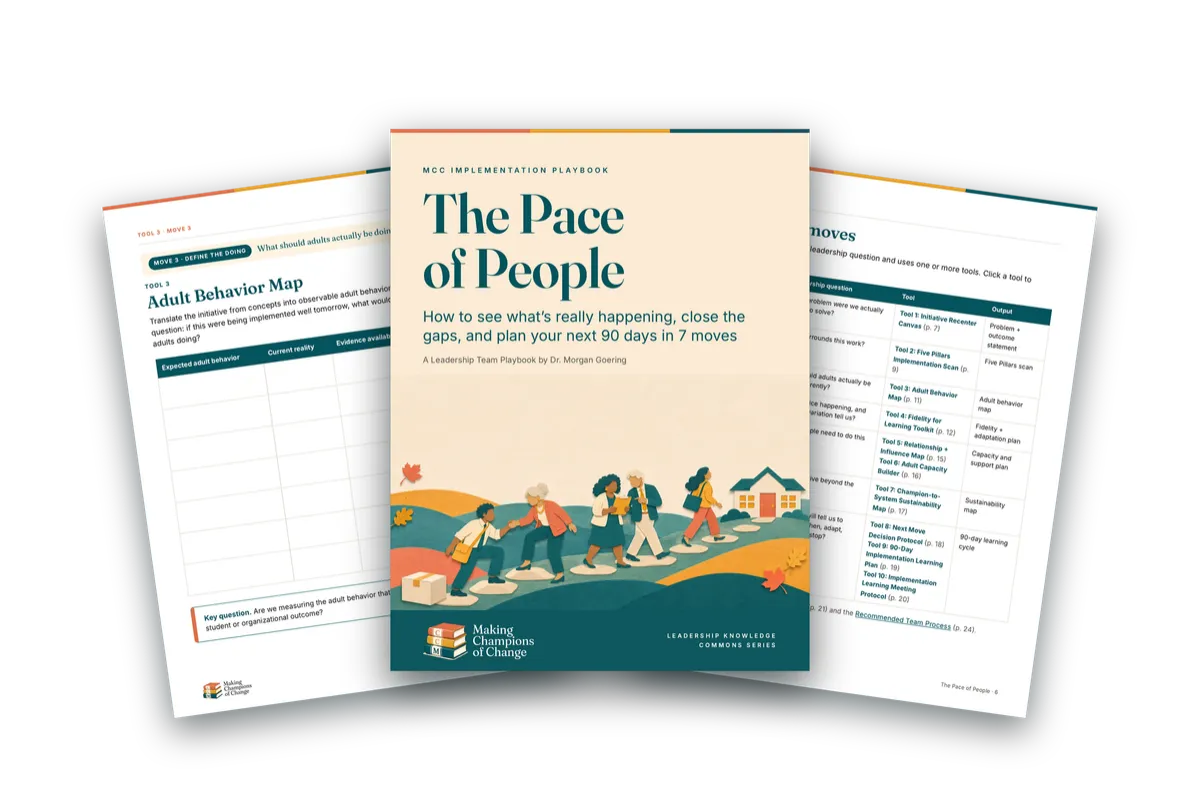
Use the Adult Behavior Map to name what adults should be doing differently, then add an adult measure alongside your student outcome with Reflect. Connect. Grow. prompts.
Talk it through with us.
Bring us the work your team is carrying. If you want another perspective on a priority, challenge, or implementation question, we can help you think through what makes sense next.
Before You Go
Think about one idea from this entry that connects to the work in front of you.
What is one thing worth noticing, discussing, or doing differently because of it?
Reflect: What stood out to you in this entry?
Connect: Where do you see this showing up in your own team or system?
Grow: What is one next step worth trying, discussing, or revisiting?

A leadership and implementation ecosystem helping education leaders turn good ideas into change that lasts.
Explore
Learn with us
Opportunities
Stay in the Conversation
Get new playbooks, leadership tools, and district stories in your inbox.
© 2026 Making Champions of Change. All rights reserved.