
You know how to read the data. But are you seeing the whole picture?
When familiar concerns keep returning despite your team’s efforts, it helps to examine what may be missing from the conversation.
Data as a Mirror gives you seven practical tools to explore what may be driving those patterns before choosing another intervention.
- Instant PDF access
- Printable tools and worksheets
- Use across your organization
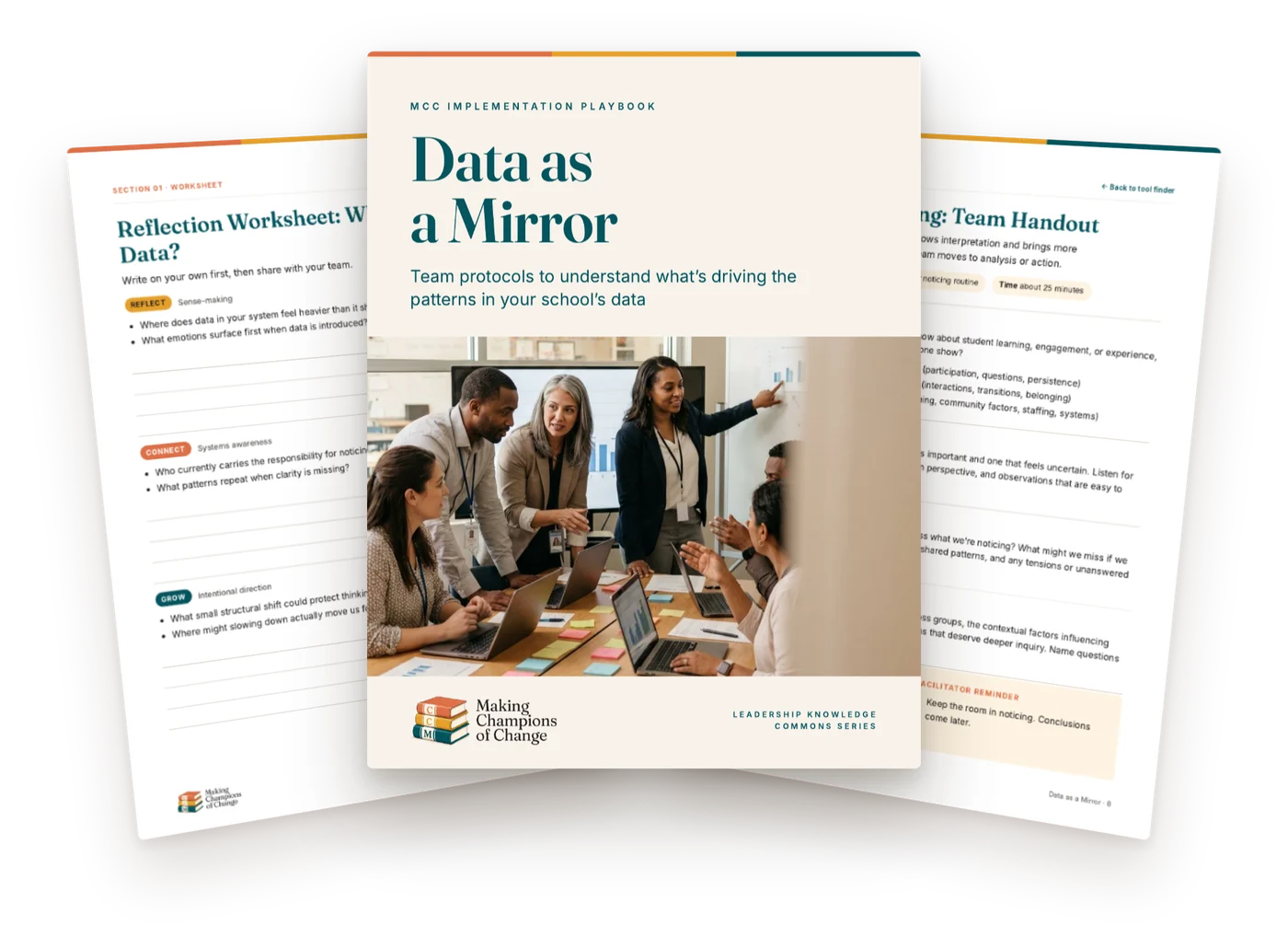

Your team has put in the work. The same concerns keep returning.
The results come in. Your team identifies a concern, agrees on a response, and puts a plan into practice.
At the next meeting, the pattern looks familiar.
Attendance remains a concern.
Behavior referrals keep coming.
A strategy takes hold in some classrooms and stalls in others.
You already understand why data matters. The harder part is figuring out what needs to change when your team’s effort hasn’t produced the progress you expected.
The way a team interprets its data shapes what it decides to do next.

Look more closely before asking staff to try something else.
An attendance discussion may need input from families about what makes getting to school difficult.
Repeated referrals may call for a closer look at classroom transitions.
Uneven implementation may reveal different understandings of what staff are being asked to do.
What if a school routine is creating an unintended barrier? Or a support exists, but students are struggling to reach it?
These are the kinds of conditions that don’t always show up on a dashboard. When we use data as a mirror, we look beyond student performance to the decisions, routines, expectations, and conditions that shape students’ experiences.
Data as a Mirror gives you structured ways to bring those perspectives into the room and examine the assumptions shaping your decisions.
Because the way we understand a problem shapes the solutions we’re able to see.
Seven practical tools for where your team is getting stuck.
Choose the tool that fits the conversation you need. You don’t have to use all seven or follow them in order.
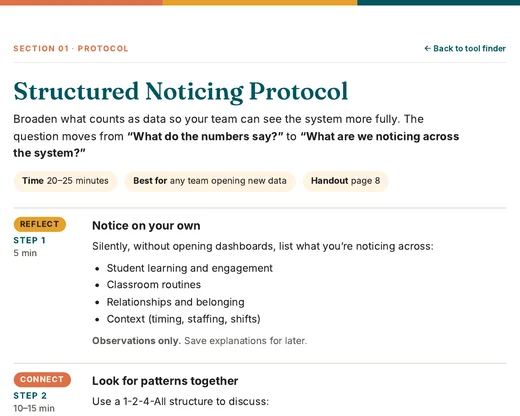
Structured Noticing Protocol
Surface classroom observations, experiences, and context before interpreting the pattern.
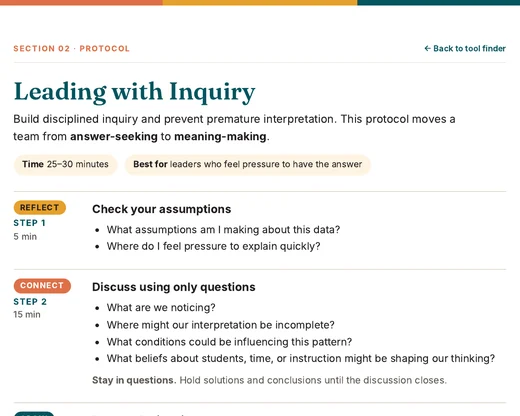
Leading with Inquiry
Ask questions that invite other perspectives and help the team examine its initial interpretation.
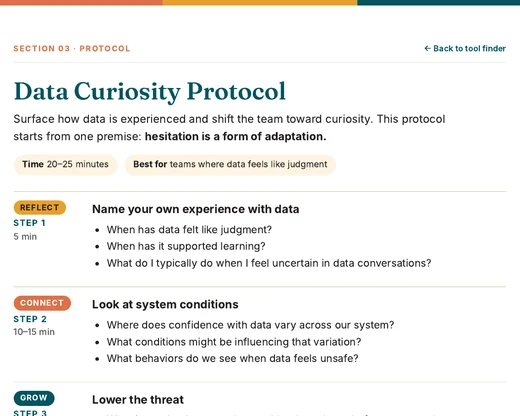
Data Curiosity Protocol
Explore what shapes participation and identify a leadership move that could make uncertainty easier to discuss.
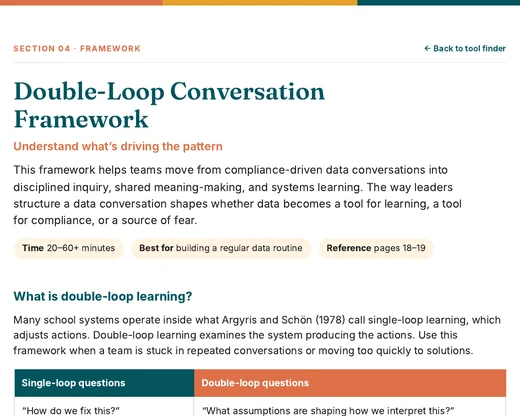
Double-Loop Conversation Framework
Examine how adult practices, assumptions, and school conditions may be contributing.
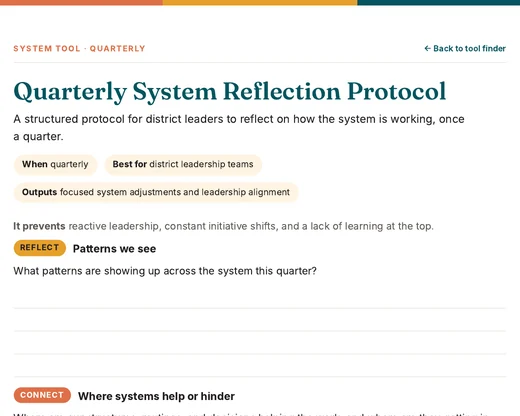
Quarterly System Reflection Protocol
Identify where structures support or hinder progress and choose one focused adjustment.
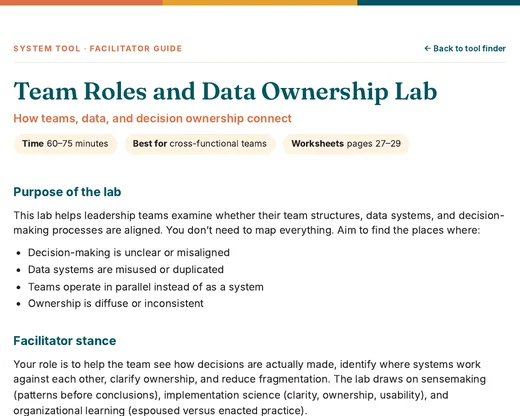
Team Roles and Data Ownership Lab
Map how teams use information and make decisions. Find unclear ownership, duplicated work, and gaps between teams.
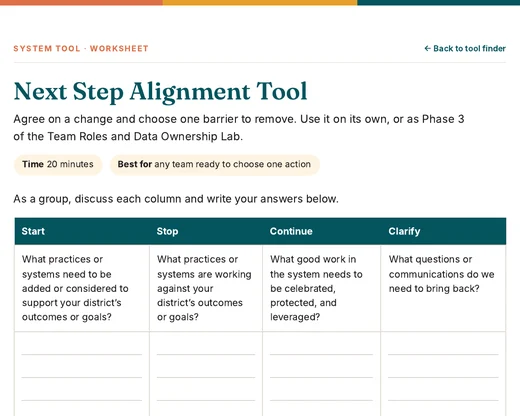
Next Step Alignment Tool
Identify what to start, stop, continue, or clarify, then choose one barrier to remove.

Open it before your next meeting. Start with one tool.
Find your starting point.
Use the situation guide and tool finder to choose what fits your team’s needs.
Prepare the conversation.
Review the prompts and timing. Print the worksheet or handout you need.
Bring it into the room.
Use the structure in a leadership meeting, PLC, coaching conversation, or system review.
Most tools take 20 to 30 minutes. The Team Roles and Data Ownership Lab is a 60- to 75-minute working session.
There’s no need to read the playbook cover to cover before using it.

Practical tools with the thinking behind them.
Your downloadable PDF includes:
- Seven team and system tools
- Printable worksheets and reference pages
- Facilitator prompts and guidance
- A situation guide and clickable tool finder
- Four learning-entry summaries with links to the full Leadership Knowledge Commons entries
- An introduction to MCC’s Reflect. Connect. Grow. adult learning framework
Created by educators who understand the work.
Data as a Mirror brings together contributions from Mandi Kopischke, Dr. Morgan Goering, Erin Potter, and Janine Gacke.
 Mandi Kopischke
 Dr. Morgan Goering
 Erin Potter
 Janine Gacke
Their experience spans classroom teaching, school social work, coaching, and school and district leadership. The playbook connects that experience to MCC’s focus on helping teams put learning into practice.
If you’re the person in the meeting asking, “What should we do with what we’re seeing?”, this playbook gives you a structure for working through that question with your team.

Get Data as a Mirror
Seven practical tools to understand what’s driving the patterns in your school’s data
Give your team a structured way to examine what it’s seeing before committing to another response.
One-time purchase · Digital PDF
- Download immediately after checkout. Your confirmation email will also include a link to your download page.
- Internal use with educators in your school, district, or organization is included.
- Need a receipt for reimbursement? One is emailed to you automatically after checkout.
By completing your purchase, you agree to the Terms of Service.
We’ll email an invoice and a W-9 to whoever handles payment for your school.
Pay with a school purchase order
Submit your school’s authorized purchase order below. As soon as we receive it, you’ll go to your download page, and we’ll email an invoice and a W-9 to the payment contact you name.
Have your purchase order and your payment contact’s details ready. Questions? Email [email protected].
Frequently asked questions
Who is this for?
School and district leaders who facilitate team conversations about student outcomes or implementation, including principals, coaches, and MTSS leads.
Is this only for assessment data?
The tools also support conversations about attendance, behavior, student experience, and implementation. They help teams consider observations and context alongside numerical results.
Do we need to use all seven tools?
Choose the tool that addresses your current challenge. The tools serve different purposes and don’t form a required sequence.
Will it tell us which intervention to choose?
The playbook helps your team examine the evidence and assumptions informing that choice. Your team selects a response based on its context and what it learns.
What if we already have a data protocol?
Use these tools where your current process needs support, such as inviting more perspectives, examining recurring assumptions, or clarifying who owns a decision.
How does this relate to the free Commons resources?
The full learning entries and the Double-Loop Conversation Framework are available free through MCC. The paid playbook collects the framework with companion tools, worksheets, and facilitator guidance in one PDF organized for team use.
Can I share it with my team?
Yes. Your purchase includes a single-organization license, so you can use, print, and share the playbook internally within your school, district, or organization. Resale, public posting, and distribution outside your organization aren’t included.
How do I receive it?
Download the PDF from the confirmation page after checkout. We’ll also email you a link back to that page.
Can my school pay with a purchase order or invoice?
Yes. Click “Paying with a school purchase order or invoice?” under the order form and submit your school’s authorized purchase order. You’ll get access to the playbook as soon as we receive it, and we’ll email an invoice and a W-9 to your school’s payment contact.
What is the refund policy?
All sales are final because this is an immediately accessible digital product. For download assistance, contact [email protected].

You’ve learned how to use data to identify problems. Now help your team understand what’s driving them.
Choose a tool that fits where your team is getting stuck. Use the prompts and worksheets to examine what may be contributing before deciding on another response.
Get the Playbook · $24.99- Instant PDF access
- One-time purchase
- Use across your organization

A leadership and implementation ecosystem helping education leaders turn good ideas into change that lasts.
Explore
Learn with us
Opportunities
Stay in the Conversation
Get new playbooks, leadership tools, and district stories in your inbox.
© 2026 Making Champions of Change. All rights reserved.