
June 2026 Series: The Human Side of Teacher Retention (Entry 4: The Learners in the Building: Honoring the Human Drive to Grow)
Relationships
June Learning Series: Entry 4
The Learners in the Building: Honoring the Human Drive to Grow
Dr. Amy Pahl · June 25, 2026 · 8 min read

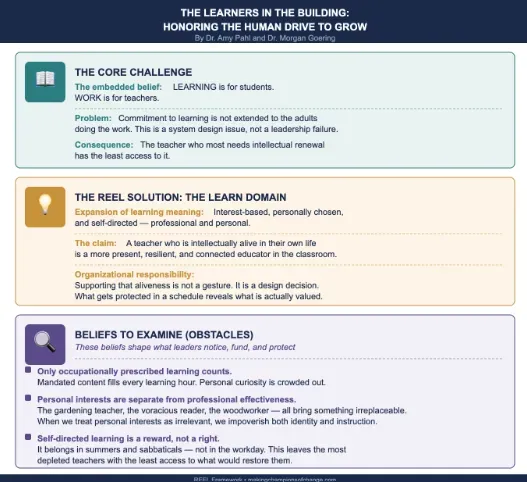
There is a belief so embedded in school culture that it rarely gets examined: learning is for students. Professional time is for work. The two are understood as distinct categories through unspoken norms that shape how time gets used.
This is not a failure of leadership. It is the natural result of a system built around student outcomes, where professional time has always been organized around what the institution needs rather than what sustains the people inside it. The irony is one that most teachers recognize immediately when it is named: the profession most committed to learning as a human value has not always extended that same commitment to the adults doing the work. That gap is not intentional, nor is it inevitable.
The fourth domain of the REEL framework — Learn — is this series' answer to that irony. It is an expansion of what learning is allowed to mean: interest-based, personally chosen, and self-directed. It rests on a simple claim with significant consequences: the teacher who is intellectually alive in their own life is a more present, resilient, and connected educator in the classroom. Supporting that aliveness is not a gesture. It is an organizational responsibility.
Beliefs in Practice
The belief that only occupationally prescribed learning counts shows up in behavior long before it becomes policy. It shows up in the professional development calendar that fills every learning hour with district-determined content. In the leader who genuinely cares about teachers but never asks: what have you been curious about lately?
A second belief sits underneath the first: that personal interests are separate from professional effectiveness. This sounds reasonable until you examine what it costs. The teacher who gardens brings something to a science classroom that a non-gardening teacher does not. The teacher who reads voraciously brings something to every conversation about student literacy. When we treat personal interests as irrelevant to professional identity, we impoverish both.
The most consequential belief operates below awareness: self-directed learning is a reward, not a right — it belongs in summers and sabbaticals. When that belief prevails, the teacher who most needs intellectual renewal is precisely the one with least access to it. That is not a personnel problem. It is a design problem.
Leadership Practice
The first move is the simplest and the rarest: naming interest-based learning as legitimate, out loud, in a room full of teachers. Not as a bonus or a wellness initiative, but as a professional value. When a leader picks up a gardening magazine at the beginning of a staff meeting and asks who has read something interesting lately — not something curriculum-related, just something interesting — there is a change in what the room believes is valued. That is a small act with an outsized retention consequence.
What follows from that naming is structural honesty. Before leaders can protect time for self-directed learning, they have to examine what the current use of professional time is actually communicating. If every planning period is consumed by required tasks, every staff meeting by district content, and every professional development day by compliance training, the message is already clear regardless of what the mission statement says. Protecting even fifteen minutes of genuinely unstructured, self-directed time — and defending it when the calendar gets crowded — is a leadership act that teachers notice and remember.
The restraint required here is the willingness to not fill the space. Leaders who are comfortable with purposeful, directed professional time often find unstructured learning time uncomfortable — it looks, on the surface, like unproductivity. The belief that needs examining is: if I can't measure it, it isn't working. Self-determination theory is unambiguous that autonomy, competence, and relatedness — the three conditions intrinsically motivated learning produces — are not soft benefits (Deci & Ryan, 2000). They are measurable drivers of engagement, resilience, and retention. What gets protected in a schedule reveals what is actually valued. Interest-based learning deserves to be one of those things.
System & Structure Lens
A system that values interest-based learning makes that visible in the environment. When a school builds a professional library, the breadth of that collection is its own statement — books on education and leadership sitting alongside titles on mindfulness, history, gardening, and design. Likewise, when a staff lounge offers magazines and quick reads that go beyond professional development — outdoor living, woodworking, travel, sporting interests — the signal is the same. Both choices communicate something that no policy document can: we value your whole intellectual life, not just the parts that map onto your job description. That kind of environment costs relatively little to build, and returns a teacher who feels seen as a whole person in the place where a third of their waking life is spent.
The audit a leader needs to run is simple: walk through your building and ask what the physical environment communicates about learning. Are there books? Are they current and varied? Are there comfortable spaces where a teacher could read for fifteen minutes without feeling watched? Does the staff meeting agenda ever include someone sharing something they learned that had nothing to do with the curriculum? The answers to those questions describe the Learn environment more accurately than any policy document will.
Learn may be the most accessible entry point into the REEL framework for a staff that is tired. It does not require a committee, a policy change, or a difficult conversation. It requires a library, a lounge with something worth reading, and a leader willing to name curiosity as a professional value. But its accessibility should not be mistaken for simplicity — what Learn does for the whole framework is profound. Restoration without ongoing renewal eventually runs dry. Community without shared curiosity stays surface-level. Voice without intellectual confidence stays cautious.
Interest-based learning is what keeps the other three domains alive over time, because it addresses something the others cannot reach on their own: the part of a person that needs to feel genuinely alive to something, not just supported through difficulty. A teacher who is absorbed in something they chose — who is growing in a direction that matters to them — arrives differently. Not just less depleted. More themselves. And that is what the whole framework is ultimately building toward.
Reflect. Connect. Grow.
Reflect. Think of a time you asked for teacher input on a decision that was already largely settled. What did you believe you were offering? What were teachers actually receiving?
Connect. When engagement opportunities favor the teachers who always step forward, who is quietly left at the edges? What would it take to design something they could actually step into?
Grow. What is one moment in the next thirty days where you could make the connection between what was heard and what was decided visible — and let that moment be the beginning of something?
Looking Forward
This series began with a belief: that the culture of a school is built or broken by the daily decisions leaders make about how the people in their buildings are seen, supported, and valued. It traced that belief through four domains — Restore, Engage, Empower, Learn — not as a checklist but as an integrated orientation toward the whole human being who shows up to teach every day.
What the research keeps finding, and what this series has tried to make visible, is that teachers stay where they feel restored enough to sustain the work, connected enough to belong, heard enough to invest, and alive enough in their own learning to bring something genuine to their classrooms. None of those conditions arrive by accident. All of them are built — slowly, structurally, through small decisions that accumulate into a culture.
The most useful question to carry forward is not which domain to start with. It is the honest one: do the people in my building feel restored, connected, heard, and alive to their own learning — and how would I actually know? That question, returned to regularly and answered honestly, is the beginning of a different kind of school. Not a finished one. But one genuinely oriented toward the humans at its center, one that keeps teachers.
References
Deci, E. L., & Ryan, R. M. (2000). The "what" and "why" of goal pursuits: Human needs and the self-determination of behavior. Psychological Inquiry, 11(4), 227–268.
Pahl, A. L. (2022). Addressing teacher attrition through trauma-informed practices in the workplace (Publication No. 714) [Doctoral dissertation, Minnesota State University Moorhead]. RED: Repository for Educational Documentation.
Explore More In this series
Entry 4 · The Learners in the Building: Honoring the Human Drive to Grow

Take it to Your Team
Turn the ideas from this series into a practical team conversation with tools, worksheets, and Reflect. Connect. Grow. prompts designed for application.
Talk it through with us.
Bring us the work your team is carrying. If you want another perspective on a priority, challenge, or implementation question, we can help you think through what makes sense next.
Before You Go
Think about one idea from this entry that connects to the work in front of you.
What is one thing worth noticing, discussing, or doing differently because of it?
Reflect: What stood out to you in this entry?
Connect: Where do you see this showing up in your own team or system?
Grow: What is one next step worth trying, discussing, or revisiting?
Before You Go
Think about one idea from this entry that connects to the work in front of you.
What is one thing worth noticing, discussing, or doing differently because of it?
Reflect: What stood out to you in this entry?
Connect: Where do you see this showing up in your own team or system?
Grow: What is one next step worth trying, discussing, or revisiting?
Continue the work.
This entry connects to MCC's wider ecosystem of tools, learning spaces, and implementation support. A few natural next steps:
To reflect on your own: download a related playbook.
To learn with others: join a Professional Learning Network.
To build and fund the work: start a Leadership Laboratory conversation.

A leadership and implementation ecosystem helping education leaders turn good ideas into change that lasts.
Explore
Learn with us
Opportunities
Stay in the Conversation
Get new playbooks, leadership tools, and district stories in your inbox.
© 2026 Making Champions of Change. All rights reserved.