
The Work Between Us · Entry 3 of 4
Relationships
Reintegration Meetings: A Critical Tool for Student Success and Belonging
Dr. Morgan Goering · April 28, 2025 · 8 min read
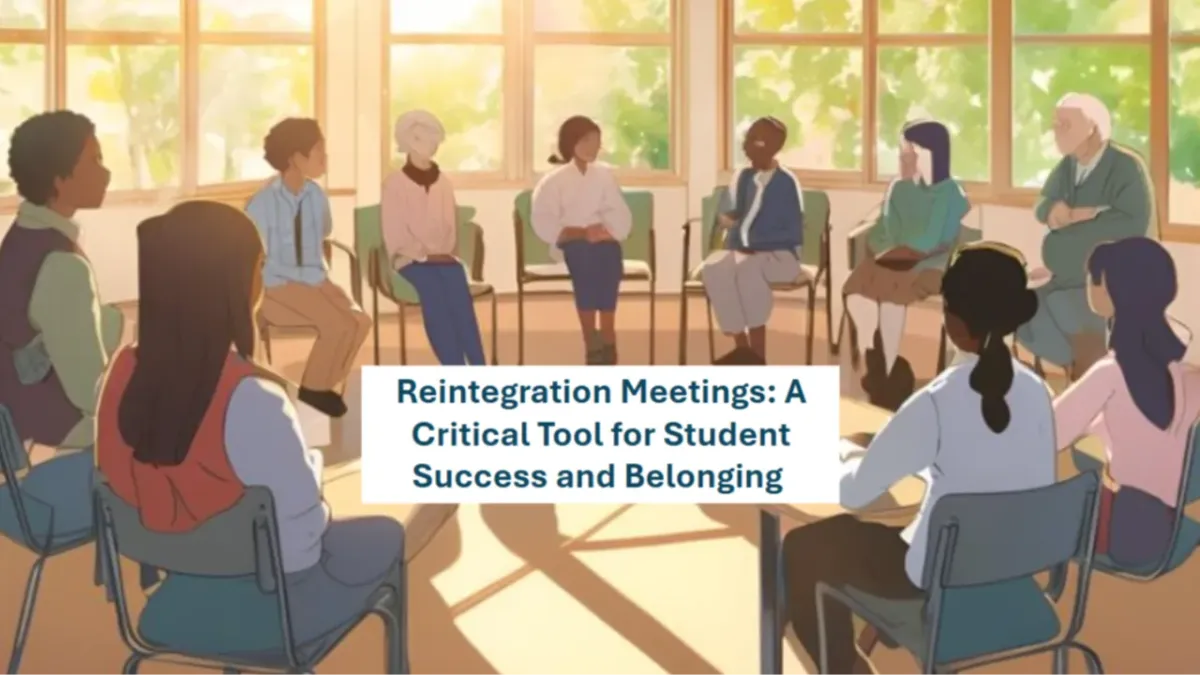
Schools are designed to be places of learning, growth, and connection. Yet, when students face disciplinary actions like suspensions, there’s often a disruption in their sense of belonging and academic progress. Research shows that students who are suspended are at greater risk of falling behind academically, becoming disengaged from school, and experiencing future disciplinary actions (Gregory et al., 2010).
Reintegration meetings address this by creating an opportunity for meaningful reentry into the school community. They repair relationships, set expectations, and offer tailored support to students returning from exclusionary discipline.
What Are Reintegration Meetings?
A reintegration meeting is a structured conversation held between the student, their family, and school staff upon the student’s return from a suspension or extended absence. Research underscores that restorative practices like reintegration meetings reduce suspensions and improve school climates (Evans & Lester, 2012).
Key components of a reintegration meeting include:
Acknowledgment: Recognizing the incident that led to the student’s absence.
Support: Addressing challenges the student faced and providing school-based solutions.
Accountability: Encouraging the student to take responsibility for their actions while focusing on growth.
Collaboration: Ensuring that all parties—students, families, and staff—agree on shared expectations and next steps.
Why Reintegration Meetings Are Essential
1. Restoring Trust and Relationships
Disciplinary actions often leave students feeling isolated and mistrusted. Reintegration meetings provide a safe space to rebuild connections and ensure that students feel valued and supported. According to Brown et al. (2019), fostering relationships with students after disciplinary incidents leads to increased engagement and a stronger sense of belonging.
2. Promoting Equity
Data shows that students from marginalized groups, such as Black and Hispanic students, are disproportionately suspended and expelled (Losen et al., 2015). Reintegration meetings help address systemic inequities by ensuring personalized support and reducing repeat discipline.
3. Preventing Recidivism
Restorative approaches have been shown to reduce repeat offenses and improve behavior. Studies indicate that when students feel heard and supported, they are less likely to engage in future conflict (Kline, 2016).
4. Creating a Safe and Inclusive Environment
When reintegration is done thoughtfully, it signals to the student and their peers that mistakes are opportunities for growth—not permanent labels. This aligns with findings that inclusive and supportive school environments improve student outcomes across all demographics (Osher et al., 2018).
How to Implement Effective Reintegration Meetings
1. Plan the Meeting Thoughtfully
Who should attend: The student, a family member or guardian, the teacher(s), and an administrator or support staff member.
When to hold it: As soon as possible after the student’s return.
2. Use a Strength-Based Approach
Highlight the student’s potential and past successes.
Focus on solutions rather than punishment.
Research supports using strength-based approaches to improve student self-esteem and foster engagement (Hammond, 2015).
3. Develop a Reentry Plan
Collaboratively identify supports (e.g., counseling, check-ins, peer mentors).
Set clear, achievable goals for behavior and academic performance.
4. Follow Up
Schedule a check-in a few weeks later to evaluate progress and address any new challenges
What Schools Gain from Reintegration Meetings
Stronger Community Bonds: Students and families feel seen, valued, and supported.
Improved Academic Outcomes: Students are more likely to engage in learning when they feel connected (Wentzel, 2016).
Reduced Conflict: Open communication helps resolve underlying issues and prevent future incidents.
A Shift Toward Restorative Practices: Reintegration meetings align with PBIS and restorative discipline frameworks, moving schools away from exclusionary practices.
Reintegration is a Step Toward Equity and Belonging
Reintegration meetings are more than just a step in the disciplinary process—they’re a declaration that every student deserves a fresh start. By investing time and energy into these meetings, schools can build a culture that prioritizes belonging, accountability, and growth.
Resources for Reintegration Success
At Making Champions of Change, we believe in equipping schools with tools that create lasting, positive change—not just in theory, but in practice.
✨ For step-by-step reintegration protocols, restorative conversation templates, reentry planning guides, and more, explore our Restorative Practice & Non-Exclusionary Discipline Toolkit.
This ready-to-use resource includes:
Reintegration meeting templates and conversation scripts
Behavior reflection tools and restorative circle resources
Strategies to repair harm, rebuild trust, and promote accountability
Staff training materials to build a shared foundation for restorative practices
Help your staff feel confident supporting students after disciplinary absences—and create a school culture where every student is given the chance to thrive, even after setbacks.
Visit MakingChampionsofChange.com to learn more about our resources and professional development offerings.
Together, we can build schools where every student feels seen, supported, and set up for success.
References
Brown, C., Anagnostopoulos, D., & McCrory Calarco, J. (2019). Restorative Practices in Schools: Building Relationships to Improve Discipline and Equity.
Evans, K. R., & Lester, J. N. (2012). Restorative justice in education: What we know so far. Peabody Journal of Education, 87(2), 139-149.
Gregory, A., Skiba, R. J., & Noguera, P. A. (2010). The achievement gap and the discipline gap: Two sides of the same coin? Educational Researcher, 39(1), 59-68.
Hammond, Z. (2015). Culturally Responsive Teaching and the Brain. Corwin Press.
Losen, D. J., Hodson, C. L., Keith, M. A., Morrison, K., & Belway, S. (2015). Are we closing the school discipline gap? The Center for Civil Rights Remedies.
Osher, D., Sprague, J., Weissberg, R. P., & Axelrod, J. (2018). Creating Safe, Equitable, Engaging Schools: A Comprehensive, Evidence-Based Approach. Harvard Education Press.
Wentzel, K. R. (2016). Student motivation and engagement in the classroom. Academic Press
Ready to go further?
See the ways MCC partners with leaders and districts.
Talk it through.
Bring us your goals and what feels stuck.
In this series
Entry 1 · Where trust begins
Entry 2 · Naming what a team notices
Entry 4 · Keeping connection over time
Continue the work.
This entry connects to MCC's wider ecosystem of tools, learning spaces, and implementation support. A few natural next steps:
To reflect on your own: download a related playbook.
To learn with others: join a Professional Learning Network.
To build and fund the work: start a Leadership Laboratory conversation.
Continue the work.
This entry connects to MCC's wider ecosystem of tools, learning spaces, and implementation support. A few natural next steps:
To reflect on your own: download a related playbook.
To learn with others: join a Professional Learning Network.
To build and fund the work: start a Leadership Laboratory conversation.
Join the Commons
Stay in the conversation.
Get new reflections, tools, and field learning in your inbox. No pressure to keep up perfectly.
Explore more entries

What Counts as Data?

Moving From Fear to Curiosity

How Teams Learn to See the System

A leadership and implementation ecosystem helping education leaders turn good ideas into change that lasts.
Explore
Learn with us
Opportunities
Stay in the Conversation
Get new playbooks, leadership tools, and district stories in your inbox.
© 2026 Making Champions of Change. All rights reserved.